Monday, February 8, 2010

Wired Chinese Not Worried About Google

From THOnline:

Nation's Web users seem indifferent to the online giant's threat to pull out over censorship.

BEIJING -- A world without Google? They can imagine it just fine in China. After all, it's not like losing "World of Warcraft."

The online giant's threat to pull out of China over censorship has drawn little reaction among the country's 384 million Internet users. No flood of complaints to China's consumer rights agency, like the tens of thousands received in one day when the online fantasy game "World of Warcraft" was yanked last year because of a bureaucratic turf battle. Nor has there been the type of fury that saw 32,000 indignant gamers participate in an online chat session on the "World of Warcraft."

Read more ....

Moon Base Alpha: If Not U.S., Then Who?

An astronaut's footprint in the lunar soil photographed during the Apollo 11 extravehicular acitivty on the moon in 1969. Which country will leave the next set of prints? NASA

From FOX News:

If the U.S. won’t be going to the moon again anytime soon, who is?

Forty years ago the U.S. raced to plant the first foot on the moon. Now, as India, Russia, South Korea and China compete to return for further exploration, the U.S has all but dropped out -- and even Buzz Aldrin thinks that may be OK.

Aldrin, speaking to FoxNews.com, says the next step for NASA should be to create a long-term plan for more ambitious efforts -- visiting Mars or a nearby asteroid -- aided by robotics and astronauts from other countries. "It's much better to take our experience and aid other countries in conducting their races," says Aldrin.

Read more ....

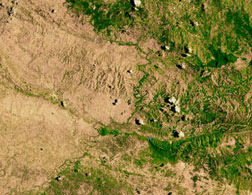
Haiti's Environmental Aftermath

Photo: Deforestation in Haiti, left, near its border with the Dominican Republic

From Slate:

What the Jan. 12 earthquake means for the country's ecosystem.


The human toll of the Jan. 12 earthquake in Haiti has been devastating, with the government reporting more than 150,000 dead in the Port-au-Prince area alone. What, if anything, does the disaster mean for the environment?

It's a small solace, but the terrifying 7.0-magnitude earthquake seems not to have caused any major, immediate damage to Haiti's ecosystem. According to Asif Zaidi, operations manager of the U.N. Environmental Program's Post-Conflict and Disaster Management Branch, there has been one small spill near a coastal oil terminal, some minor warehouse fires, and a few small landslides close to Port-au-Prince, but nothing that requires a significant emergency response.

Read more ....

Germanium Laser Breakthrough Brings Optical Computing Closer


From Gadget Lab:

Researchers at MIT have demonstrated the first laser that uses the element germanium.

The laser, which operates at room temperature, could prove to be an important step toward computer chips that move data using light instead of electricity, say the researchers.

“This is a very important breakthrough, one I would say that has the highest possible significance in the field,” says Eli Yablonovitch, a professor in the electrical engineering and computer science department of the University of California, Berkeley who was not involved in the research told Wired.com. “It will greatly reduce the cost of communications and make for faster chips.”

Read more ....

Beware Of Geoengineering Using Volcanoes' Tricks

Starving the oceans of oxygen (Image: NASA)

From New Scientist:

WE HACK the climate at our peril. Volcanoes spewed so much sulphate into the atmosphere 94 million years ago that the oceans were starved of oxygen and 27 per cent of marine genera went extinct. Geoengineering our climate could inflict a similar fate on some lakes.

So claims Matthew Hurtgen at Northwestern University in Chicago, who with his colleagues measured sulphur isotopes in sediments on the floor of the Western Interior Seaway. The WIS was a vast body of water that divided the continent of North America down the middle at the time. The team also developed a model to simulate the impact of volcanoes on ocean chemistry.

Read more
....

DARPA Wants to Override Evolution To Make Immortal Synthetic Organisms

Evolution Done Gone Wrong This will turn out well Syfy

From Popular Science:

It's been a long time since a Pentagon project from the DARPA labs truly evoked a "WTF DARPA?!" response, but our collective jaw dropped when we saw the details on a project known as BioDesign. DARPA hopes to dispense with evolutionary randomness and assemble biological creatures, genetically programmed to live indefinitely and presumably do whatever their human masters want. And, Wired's Danger Room reports, when there's the inevitable problem of said creatures going haywire or realizing that they're intelligent and have feelings, there's a planned self-destruct genetic code that could be triggered.

Read more ....

Sunday, February 7, 2010

NASA, GM Take Giant Leap in Robotic Technology

Robonaut2 -- or R2 for short -- is the next generation dexterous robot, developed through a Space Act Agreement by NASA and General Motors. It is faster, more dexterous and more technologically advanced than its predecessors and able to use its hands to do work beyond the scope of previously introduced humanoid robots. (Credit: NASA)

From Science Daily:

ScienceDaily (Feb. 7, 2010) — Robonaut is evolving.

NASA and General Motors are working together to accelerate development of the next generation of robots and related technologies for use in the automotive and aerospace industries.

Engineers and scientists from NASA and GM worked together through a Space Act Agreement at the agency's Johnson Space Center in Houston to build a new humanoid robot capable of working side by side with people. Using leading edge control, sensor and vision technologies, future robots could assist astronauts during hazardous space missions and help GM build safer cars and plants.

Read more ....

The World's Weirdest Weather


From Live Science:

As if tornadoes, hurricanes and blizzards weren't enough to keep us on our toes, Mother Nature occasionally surprises us with some truly odd weather phenomena: From whirlwinds of fire to bloody rains, it's a strange world of weather out there. - Andrea Thompson

Read more ....

FCC: iPad Use Could Further Strain AT&T 3G

Image: (Credit: Apple)

From CNET:

Although Apple's iPad has yet to hit the market, the Federal Communications Commission has expressed concern over its potential impact on AT&T's 3G network.

Without naming AT&T, which has secured a carrier deal for the tablet device, Phil Bellaria, director of scenario planning, and John Leibovitz, deputy chief of the Wireless Telecommunications Bureau, outlined their concerns in an FCC blog post Monday:

Read more ....

How Sperm Swim: A Clue For Male Contraception?

Photo: 3D4Medical.com/Getty

From Time Magazine:

Though sperm are generally considered pretty wriggly little guys, before they are launched into action, so to speak, they aren't racing around. While researchers have long known that what gets them swimming is a change in internal pH level—the more alkaline their pH, the more aggressively they swim—until now, the mechanism by which sperm rapidly drop protons, which changes their pH from acidic to alkaline, wasn't clear. According to this new study, published in the journal Cell, sperm are equipped with tons of tiny little pores that, when open, enable them to release protons and get a move on.

Read more ....

Giant Meteorites Slammed Earth Around A.D. 500?

An asteroid hurtles toward Earth in an artist's rendering. Illustration by Detlev van Ravenswaay, Astrofoto, Peter Arnold Images, Photolibrary

From National Review:

Pieces of a giant asteroid or comet that broke apart over Earth may have crashed off Australia about 1,500 years ago, says a scientist who has found evidence of the possible impact craters.

Satellite measurements of the Gulf of Carpentaria (see map) revealed tiny changes in sea level that are signs of impact craters on the seabed below, according to new research by marine geophysicist Dallas Abbott.

Read more ....

Top British Scientist Says UN Panel Is Losing Credibility

From Times Online:

A LEADING British government scientist has warned the United Nations’ climate panel to tackle its blunders or lose all credibility.

Robert Watson, chief scientist at Defra, the environment ministry, who chaired the Intergovernmental Panel on Climate Change (IPCC) from 1997 to 2002, was speaking after more potential inaccuracies emerged in the IPCC’s 2007 benchmark report on global warming.

The most important is a claim that global warming could cut rain-fed north African crop production by up to 50% by 2020, a remarkably short time for such a dramatic change. The claim has been quoted in speeches by Rajendra Pachauri, the IPCC chairman, and by Ban Ki-moon, the UN secretary-general.

Read more ....

Before The Swiss Army Knife, What Did Soldiers Use?

(Click Image to Enlarge)
Inspired: The Roman army pen knife, a precursor to today's popular Swiss Army accessory

The Roman Army Knife: Or How The Ingenuity Of The Swiss Was Beaten By 1,800 Years -- The Daily Mail:

The world's first Swiss Army knife' has been revealed - made 1,800 years before its modern counterpart.

An intricately designed Roman implement, which dates back to 200AD, it is made from silver but has an iron blade.

It features a spoon, fork as well as a retractable spike, spatula and small tooth-pick.

Experts believe the spike may have been used by the Romans to extract meat from snails.

Read more ....

Surf's Up As Pacific Waves Grow


From New Scientist:

GOOD news surfers: waves in the north-east Pacific are getting taller, and the height of the most extreme "100-year" waves is increasing fastest.

Previous data had shown wave height to be increasing in the north-east Pacific and north Atlantic since the late 1980s. Now measurements from a deep-water buoy moored off the Oregon coast since the mid-1970s indicate that the "100-year" waves - the monster waves with a 1 per cent chance of occurring in any given year - could be 40 per cent larger than previous estimates, at 14 metres high.

Read more ....

Heinz' New Ketchup Packet Dips, Squeezes And Scores (With Video!)


From Popular Mechanics:

You know the fast food driving drill: Heading down the Interstate, you carefully unfold the wrapper to your burger and make a place on your lap. You reach for the french fries and follow one of two strategies—take them from the box, one-by-one and paint them with ketchup from the packet, quickly running out of your supply; or squeeze a puddle of Heinz on the wrapper for dipping, risking stained pants and messy hands. Isn't there a better way?

Read more ....

Airwaves Abandoned by TV Could Beam High-Speed Internet Everywhere

Internet in the Ether Brian Kaas Design

From Popular Science:

When TV went digital, Verizon, AT&T and other cellphone carriers shelled out a combined $19 billion for some of the freed-up airwaves, known as white spaces. Now wireless company Spectrum Bridge is using the parts that are still unclaimed to deliver high-speed Internet from its broadcast tower to your laptop computer.

Read more ....

Google To Air Ad During Super Bowl?


From CNET:

Perhaps Google CEO Eric Scmidt's tweet said it all.

"Can't wait to watch the Super Bowl tomorrow. Be sure to watch the ads in the 3rd quarter (someone said 'Hell has indeed frozen over')," he wrote Saturday.

This tweet appears to be a response to speculation by John Battelle, founder of Federated Media Publishing, that one of the world's most ad-diffident companies would be running a brand ad during the Big Game's third quarter. (Kickoff is just after 3:20 p.m. PST Sunday on CBS, publisher of CNET.)

Read more ....

Computers That Use Light Instead of Electricity? First Germanium Laser Created

Image: MIT researchers have demonstrated the first laser built from germanium that can produce wavelengths of light useful for optical communication. (Credit: Graphic by Christine Daniloff)

From Science Daily:

ScienceDaily (Feb. 5, 2010) — MIT researchers have demonstrated the first laser built from germanium that can produce wavelengths of light useful for optical communication. It's also the first germanium laser to operate at room temperature. Unlike the materials typically used in lasers, germanium is easy to incorporate into existing processes for manufacturing silicon chips. So the result could prove an important step toward computers that move data -- and maybe even perform calculations -- using light instead of electricity. But more fundamentally, the researchers have shown that, contrary to prior belief, a class of materials called indirect-band-gap semiconductors can yield practical lasers.

Read more ....

Genes Help Explain Who Gets Fit


From Live Science:

When you put in hours at the gym, you expect to get fitter. It turns out, that assumption doesn't hold true for everyone. A new study suggests specific genes may determine, at least in part, how much we really benefit from exercise.

While "benefit from exercise" can mean plenty of things, from slimming down to boosting one's ability to complete a marathon, the researchers specifically looked at what is called VO2 max, or aerobic capacity. This is a measure of how much blood your heart pumps and how much oxygen your muscles consume when they constrict to, say, move your legs on a treadmill.

Read more ....

Darwin Out Of Africa 45,000 Years Ago

Charles Darwin's family history has been mapped. His ancestors left Africa 45,000 years ago.

From Cosmos:

SYDNEY: The father of evolution Charles Darwin was a direct descendant of the Cro-Magnon people, whose entry into Europe 30,000 years ago heralded the demise of Neanderthals, scientists revealed.

Darwin, who hypothesised that all humans evolved from common ancestors in his seminal 1859 work On the Origin of Species, came from Haplogroup R1b, one of the most common European male lineages, said genealogist Spencer Wells.

Read more ....