A Science News Aggregator That Covers Stories in the World Of Science And Technology.
Thursday, February 25, 2010
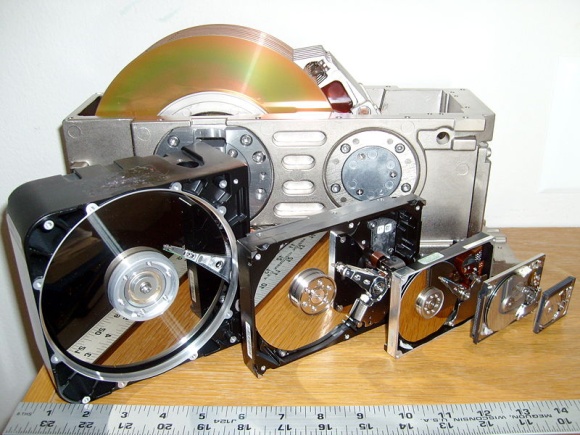
Amazing Facts And Figures About The Evolution Of Hard Disk Drives
From Pingdom:
It took 51 years before hard disk drives reached the size of 1 TB (terabyte, i.e. 1,000 GB). This happened in 2007. In 2009, the first hard drive with 2 TB of storage arrived. So while it took 51 years to reach the first terabyte, it took just two years to reach the second.
This article looks back at how hard disk drives have evolved since they first burst onto the scene in 1956. We’ll examine the radical changes over time for three different aspects of HDDs: Size, storage space, and price.
Read more ....
Genetic Link Between Misery and Death Discovered; Novel Strategy Probes 'Genetic Haystack'
Interaction between nerves (red) and tumor cells (blue) in an ovary provides one way by which stress biochemistry signals can be distributed to sites of disease in the body. (Credit: Image courtesy of University of California - Los Angeles)From Science Daily:
Science Daily (Feb. 25, 2010) — In ongoing work to identify how genes interact with social environments to impact human health, UCLA researchers have discovered what they describe as a biochemical link between misery and death. In addition, they found a specific genetic variation in some individuals that seems to disconnect that link, rendering them more biologically resilient in the face of adversity.
Read more ....
Brain's 'Fairness' Spot Found
Humans tend not to like unequal situations, and now scientists have found the first evidence that this behavior is reflected in the human brain. Here, an fMRI scan of a human brain showing activity in the striatum and prefrontal cortex, regions of the brain thought to be involved in how people evaluate rewards. Credit: Elizabeth Tricomi, Rutgers University.From Live Science:
At some point in our lives, we've all cried "It's not fair!" In fact, it's human nature for us to dislike unequal situations, and we often try to avoid or remedy them. Now, scientists have identified the first evidence of this behavior's neurological underpinnings in the human brain.
The results show that the brain's reward center responds to unequal situations involving money in a way that indicates people prefer a level playing field, and may suggest why we care about the circumstances of others in the first place.
Read more ....
Hearts Actually Can Break

From New York Times:
Dorothy Lee and her husband of 40 years were driving home from a Bible study group one wintry night when their car suddenly hit the curb. Mrs. Lee looked at her husband, who was driving, and saw his head bob a couple of times and fall on his chest.
In the ensuing minutes, Mrs. Lee recalls, she managed to avoid a crash while stopping the car, called 911 on her cellphone and tried to revive her husband before an ambulance arrived. But at the hospital, soon after learning her husband had died of a heart attack, Mrs. Lee's heart appeared to give out as well. She experienced sudden sharp pains in her chest, felt faint and went unconscious.
Read more ....
From Ocean To Ozone: Earth's Nine Life-Support Systems
(Click Image To Enlarge)We have already overstepped three of nine planetary boundaries and are at grave risk of transgressing several others.
From New Scientist:
UP TO now, the Earth has been very kind to us. Most of our achievements in the past 10,000 years - farming, culture, cities, industrialisation and the raising of our numbers from a million or so to almost 7 billion - happened during an unusually benign period when Earth's natural regulatory systems kept everything from the climate to the supply of fresh water inside narrow, comfortable boundaries.
Read more ....
EU Launches Antitrust Inquiry Into Google 'Dominance'
From Times Online:
The European Commission has launched a preliminary antitrust inquiry into Google after three companies complained that the US giant's dominant search engine penalises potential competitors and keeps advertising prices artificially high.
The European Commission has written to Google to find out how its search functions work, following allegations from the UK price comparison site Foundem, an online French guide to legal services, ejustice.fr and the Germany-based shopping portal Ciao, owned by Microsoft.
Read more ....
Enceladus: Nasa Spacecraft Records Dramatic Pictures Of Saturn's Moon 'Spitting'
From The Telegraph:
Dramatic pictures captured by a Nasa spacecraft of Saturn's icy moon, Enceladus, “spitting” out water have left scientists astounded.
The space agency’s Cassini spacecraft fly-by has captured new evidence that Saturn's sixth-largest moon is “bursting at the seams”.
The pictures, taken about 1,000 miles from the moon's surface, a forest of more than 30 individual icy plumes of water – including 20 that have never been recorded – can be seen erupting, or “spitting”, from fractures around its southern pole surface.
Read more ....
Met Office To Re-Examine 150 Years Of Temperature Data In The Wake Of The Climategate Scandal
From The Daily Mail:
Temperature records dating back more than 150 years are to be re-examined by the Met Office because public belief in global warming has plummeted.
The re-analysis, which was approved at a conference in Turkey this week, comes after the climate change email scandal which dealt a severe blow to the credibility of environmental science.
The Met Office says that the review is 'timely' and insists it does not expect to come to a different conclusion about the progress of climate change.
Read more ....
Six Tricks That Alien Trackers Could Use
From New Scientist:
So far, the search for extraterrestrial intelligence has focused on listening for radio signals deliberately sent our way. But even if alien civilisations are not trying to get our attention, their activities could produce detectable signs. Here are a few things we might detect, most of which are discussed in a recent paper by Richard Carrigan of the Fermi National Accelerator Laboratory in Batavia, Illinois.
Read more ....
NSF Puts Up $25 Million To Research Biological Machines
From Popular Science:
What would you do with $25 million? If you answered "create a center to research the development of programmable, highly sophisticated biological machines," we regret to inform you the National Science Foundation and MIT have beaten you to the punch. The Emergent Behaviors of Integrated Cellular Systems Center (EBICS), will not only advance research in the emerging experimental discipline of engineered biological systems, but will lay an extensive educational groundwork for research in the field going forward.
Read more ....
Brain 'Hears' Sound Of Silence
From Discovery News:
While we think of silence as the absence of sound, the brain detects it nonetheless.
THE GIST:
* The brain responds not only to sound but also to silence, according to a new study.
* Different pathways in the brain respond to the onset and the offset of sounds.
* Better knowing how the brain organizes and groups sounds could lead to more effective hearing therapies and devices.
While we characterize silence as the absence of sound, the brain hears it as loud and clear as any other noise.
In fact, according to a recent study from the University of Oregon, some areas of the brain respond solely to sound termination. Rather than sound stimuli traveling through the same brain pathways from start to finish as previously thought, neuron activity in rats has shown that onset and offset of sounds take separate routes.
Read more ....
Wednesday, February 24, 2010
Grizzly Bears Move Into Polar Bear Habitat In Manitoba, Canada
From Science Daily:
Science Daily (Feb. 23, 2010) — Biologists affiliated with the American Museum of Natural History and City College of the City University of New York have found that grizzly bears are roaming into what was traditionally thought of as polar bear habitat -- and into the Canadian province of Manitoba, where they are officially listed as extirpated. The preliminary data was recently published in Canadian Field Naturalist and shows that sightings of Ursus arctos horribilis in Canada's Wapusk National Park are recent and appear to be increasing in frequency.
Read more ....
Gulp! Long-Necked Dinosaurs Didn't Bother Chewing
From Live Science:
A mom's wise words about chewing your food likely got lost on a giant, long-necked dinosaur that lived about 105 million years ago in North America. That's according to analyses of four skulls from a newly identified dinosaur species.
"They didn't chew their food; they just grabbed it and swallowed it," said study team member Brooks Britt, a paleontologist at Brigham Young University.
Read more ....
Plastic Rubbish Blights Atlantic Ocean
From The BBC:
Scientists have discovered an area of the North Atlantic Ocean where plastic debris accumulates.
The region is said to compare with the well-documented "great Pacific garbage patch".
Karen Lavender Law of the Sea Education Association told the BBC that the issue of plastics had been "largely ignored" in the Atlantic.
She announced the findings of a two-decade-long study at the Ocean Sciences Meeting in Portland, US.
Read more ....
More About Cheney's Heart Attack. How Many Can One Person Have?
From The L.A. Times:The news that former Vice President Dick Cheney suffered his fifth heart attack Monday and was admitted to a hospital, where apparently he is recovering nicely, naturally raises the question of how many heart attacks one person can have.
Five heart attacks may seem like a lot, but it really isn't, experts said. Physicians have become better at diagnosing very small heart attacks that might have passed by unobserved in the past, and improvements in therapy have made large, killer heart attacks less common.
Read more ....
Experts Warn Of Catastrophy From Cyberattacks
Experts Warn Of Catastrophy From Cyberattacks -- CNET
Computer-based network attacks are slowly bleeding U.S. businesses of revenue and market advantage, while the government faces the prospect of losing in an all-out cyberwar, experts told Senators in a hearing on Tuesday.
Read more ....
Can Twitter Make Money?
From Technology Review:
Twitter plans to become the leader in instant news--and make itself into a sustainable business in the process.
At the microblogging company Twitter's San Francisco headquarters, in the sixth-floor conference room, founder Evan Williams was declining to tell me anything about the company's strategies to earn revenues when, suddenly, his cofounder Biz Stone blurted, "Whoa!" It was 10:10 a.m. on January 7, and it would prove to be the latest Twitter Moment, showing how far the service has moved beyond its early status as an amplifier of personal minutiae and confession. A minor earthquake had just struck: a magnitude 4.1 temblor centered 45 miles to the southeast. Throughout the Bay Area, thousands of Twitter users seized their smart phones or PCs to peck out 140-character-or-less tweets--updates in the form of text messages, Web-based instant messages, or posts on Twitter's website. Quake-related tidbits coursed through the company's servers at the rate of 296 per minute, according to tracking done by the U.S. Geological Survey.
Read more ....
Sight Savers: New Weapons Trained On Blindness
From New Scientist:
It starts with a barely perceptible blurring of vision from time to time - the sort of thing you might chalk up to getting older. But when you get it checked out, there is disturbing news: you have a disease called age-related macular degeneration, or AMD.
It can progress slowly or quickly, but there is no cure. Your hopes for an idyllic retirement - reading all those books, driving to new places, or just enjoying a carefree independence - are now clouded by uncertainty.
Read more ....
DARPA Orders Smart Robotic Terminator Hands For A Better Tomorrow
From Popular Science:
Pentagon mad scientists at DARPA have continued on their quest to create killer robots by announcing a new plan for "robotic autonomous manipulators" that can emulate human hands. And by killer, we of course mean awesome. National Defense reports that the DARPA program aims to create inexpensive robotic hands that can perhaps also replace existing prosthetics for amputees.
Read more ....
Life-Like Evolution In A Test Tube
From Cosmos:
SAN DIEGO: Can life arise from nothing but a chaotic assortment of basic molecules? The answer is a lot closer following a series of ingenious experiments that have shown evolution at work in non-living molecules.
For the first time, scientists have synthesized RNA enzymes – ribonucleic acid enzymes also known as ribozymes - that can replicate themselves without the help of any proteins or other cellular components.
What’s more, these simple nucleic acids can act as catalysts and continue the process indefinitely.
Read more ....
Subscribe to:
Comments (Atom)