A Science News Aggregator That Covers Stories in the World Of Science And Technology.
Saturday, February 13, 2010
Google Shuts Down Music Blogs Without Warning
From The Guardian:
Bloggers told they have violated terms without further explanation, as years of archives are wiped off the internet.
In what critics are calling "musicblogocide 2010", Google has deleted at least six popular music blogs that it claims violated copyright law. These sites, hosted by Google's Blogger and Blogspot services, received notices only after their sites – and years of archives – were wiped from the internet.
Read more ....
Hubble Telescope Captures Saturn's Eerie Twin Aurorae
From The Daily Mail:
A spectacular light show on Saturn has been captured in unique new photos of the ringed planet.
The aurora images captured by the Hubble Space Telescope (HST) were made possible by a rare chance to see the planet with its rings edge-on and both poles in view.
It takes Saturn almost 30 years to orbit the Sun, and during that time such a picture opportunity occurs only twice.
Read more ....
How Transformers Can Explode
From Popular Mechanics:
On February 12, an underground electrical transformer exploded in front of a Radio Shack on 6th Avenue, in New York City, emitting a fireball seven stories high and damaging nearby buildings. Here's how this could have happened.
A transformer from Consolidated Edison (Con Ed), New York City's sole electricity supplier, exploded from beneath the sidewalk in an underground vault yesterday, creating a fiery blast that shattered windows multiple stories high. Though no injuries were reported, offices and stores at the corner of 20th Street were left smoldering.
Investigators are still trying to answer the question: Just what lead this transformer to explode?
Read more ....
New Camera System Takes The Guesswork Out Of Baseball Stats
From Popular Science:
This could be the year that baseball-stat freaks finally crack the “Derek Jeter enigma.” A panel of coaches has awarded the New York Yankees’ shortstop four of the past six Gold Glove awards for fielding excellence. That drives statisticians nuts, because nearly every statistical model ranks Jeter’s defense below average.
Read more ....
Study Hints At Dark Matter Action
From The BBC:
Researchers in the US say they have detected two signals which could possibly indicate the presence of particles of dark matter.
But the study in Science journal reports the statistical likelihood of a detection of dark matter as 23%.
Deep underground in a lab in Minnesota experiments to detect WIMPS, or Weakly Interacting Massive Particles have been going on since 2003.
Read more ....
Friday, February 12, 2010
Models of Sea Level Change During Ice-Age Cycles Challenged
From Science Daily:
Science Daily (Feb. 12, 2010) — Theories about the rates of ice accumulation and melting during the Quaternary Period -- the time interval ranging from 2.6 million years ago to the present -- may need to be revised, thanks to research findings published by a University of Iowa researcher and his colleagues in the Feb. 12 issue of the journal Science.
Read more ....
4 Myths of Online Dating Photos Revealed
From Live Science:Guys hoping to get noticed on online dating sites should take off their shirts, at least those with six-pack abs, according to new survey results by one online matchmaker that also provide advice for gals' profile pics.
"We were sitting on a treasure trove of data," said Sam Yagan, co-founder and CEO of OkCupid. ''There are millions of experiments essentially happening on our site every day."
Read more ....
General Relativity: In Pretty Good Shape
From Discovery Magazine:If we celebrate provocative new experimental findings, we should also celebrate the careful null results (experiments that agree with existing theories) on which much of science is based. Back in October we pointed to a new analysis that used observations of gravitational lensing by large-scale structure to test Einstein’s general relativity on cosmological scales, with the intriguing result that it didn’t seem to fit. And the caveat that it probably would end up fitting once we understood things better, but it’s always important to follow up on these kinds of clues.
Read more ....
Astronomers Back Chile To Host World's Biggest Telescope
From The Telegraph:
For astronomers, it appears that not only does size really matter but so does an eye-opening location.
That is why an international group of four professional star gazers have banded together to back Chile's Atacama desert as home to the world's biggest telescope, to be built in 2018 based on its geographical advantages.
The high-altitude Armazones mountain in the desert in northern Chilean desert is the perfect place for the European Extremely Large Telescope (ELT) to be set up, because of skies that are cloud-free 360 nights a year, they say.
Read more ....
MoD's Vanguard: A Mix Of Robot Bomb Defusers And Kneepad Goo
From The Guardian:
Innovative technology at the Centre for Defence Enterprise
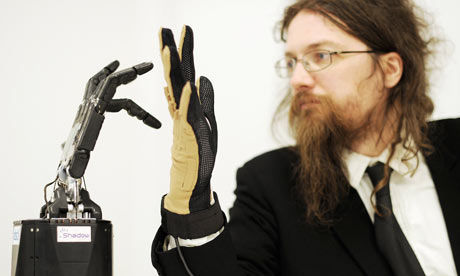
A robotic hand that could defuse bombs remotely, a camera with the ability to detect minute changes in the landscape and a mysterious orange goo that absorbs the impact of bomb blasts are among new battlefield technologies unveiled by the Ministry of Defence.
The innovations, designed to make life safer for frontline troops, are being funded by grants from the MoD's Centre for Defence Enterprise, which encourages private companies to bring their products straight to the government for development.
Read more ....
'Like Science Fiction': Astronauts Awe-Struck By Gleaming International Space Station
From The Daily Mail:
Glowing in the sunlight, this is the latest stunning shot of the International Space Station, taken from the shuttle Endeavour as it came in to dock.
Astronaut Stephen Robinson was awe-struck when he drew close to the space station, during Endeavour's approach from below.
'To look up and see what humankind could really accomplish in space was just almost impossible to believe. It seemed like science fiction,' he said.
Read more ....
The High-Tech Weather Forecasting In The 2010 Winter Olympics
From Popular Mechanics:
Weather forecasting during the Olympics is always critical, but it will be even harder than usual this time around. Not only is Vancouver the warmest city to host the winter games yet but the Vancouver-Whistler region's weather is incredibly complex because of the region's varied terrain, which spans ocean, islands and fjords and rises to 6500-foot-high mountains.
Read more ....
U.S. Army In Afghanistan Takes Delivery of New Bacterial Bioreactors To Clean Wastewater
From Popular Science:
Bacteria have deployed to Afghanistan to help the U.S. Army clean polluted wastewater. The microbes commonly appear in handfuls of dirt, but now form the main component of two new bioreactors made by scientists at Sam Houston State University in Texas.
Read more ....
Robot Stars In South Korean Plays
From The Cosmos/AFP:
SEOUL: A South Korean-developed robot played to acclaim in Robot Princess and the Seven Dwarfs and is set to take more leading theatre roles this year.
EveR-3 (Eve Robot 3) starred in various dramas last year including the government-funded Dwarfs which attracted a full house, said Lee Ho-Gil, of the state-run Korea Institute of Industrial Technology.
The lifelike EveR-3 is 157 cm tall, can communicate in Korean and English, and can express a total of 16 facial expressions – without ever forgetting her lines.
Read more ....
Tigers Evolved With Snow Leopards, Gene Study Reveals

From The BBC:
The tiger may be more ancient and distinct than we thought.
Tigers are less closely related to lions, leopards and jaguars than these other big cats are to each other, according to a new comprehensive study.
The genetic analysis also reveals the tiger began evolving 3.2 million years ago, and its closest living relative is the equally endangered snow leopard.
Read more ....
Apple Does Its Part To Battle Terrorism

From Concurring Opinions:
Today in my contracts call we were looking at boilerplate and the problems of contracts of adhesion. After class one of my students pointed out to me that buried in the fine print of its iTunes Store Terms and Conditions is a clause where Apple is doing its bit to foster non-proliferation. Clause 34(g) declares in part
You may not use or otherwise export or re-export the Licensed Application except as authorized by United States law and the laws of the jurisdiction in which the Licensed Application was obtained. In particular, but without limitation, the Licensed Application may not be exported or re-exported (a) into any U.S. embargoed countries or (b) to anyone on the U.S. Treasury Department’s list of Specially Designated Nationals or the U.S. Department of Commerce Denied Person’s List or Entity List. By using the Licensed Application, you represent and warrant that you are not located in any such country or on any such list. You also agree that you will not use these products for any purposes prohibited by United States law, including, without limitation, the development, design, manufacture or production of nuclear, missiles, or chemical or biological weapons.
Read more ....Geographers Help Map Devastation in Haiti
(Credit: MCEER, State University of New York at Buffalo)
From Science Daily:
Science Daily (Feb. 11, 2010) — In the wake of the earthquake in Haiti, University at Buffalo geography students are participating in a global effort to enhance the international response and recovery effort by helping to assess damage, using images hosted by Google Earth and the Virtual Disaster Viewer, which shares imagery of disasters from various sources.
Read more ....
Diamonds Are A Girl's Toughest Friend
This time-integrated photograph shows the high-powered laser shot at the diamond target (center), which is surrounded by several instruments. The bright white light is plasma. At just over 1 million atmospheres of pressure the diamond failed. Credit: Eugene Kowaluk/LLEFrom Live Science:
We've all heard that diamonds can cut through glass, but now scientists have found Earth's hardest solid can withstand pressures just over a million atmospheres before getting crushed.
For comparison, the pressure at the center of Earth is about 3.5 million atmospheres, according to the researchers. One atmosphere is the natural pressure of air at sea-level. And the human body can withstand about 27 atmospheres, if it's applied gradually, according to the U.S. Department of Energy.
Read more ....
Successful Airborne Laser Test Reported. Is This Program Combat Ready?
WASHINGTON (Reuters) – A U.S. high-powered airborne laser weapon shot down a ballistic missile in the first successful test of a futuristic directed energy weapon, the U.S. Missile Defense Agency said on Friday.
The agency said in a statement the test took place at 8:44 p.m. PST (11:44 p.m. EST) on Thursday /0444 GMT on Friday) at Point Mugu's Naval Air Warfare Center-Weapons Division Sea Range off Ventura in central California.
"The Missile Defense Agency demonstrated the potential use of directed energy to defend against ballistic missiles when the Airborne Laser Testbed (ALTB) successfully destroyed a boosting ballistic missile" the agency said.
Read more ....
U.S. Airborne Laser Eliminates Target Missile -- Global Security Newswire
U.S. Air Force's Laser Air Armada Nears Combat Readiness -- Daily Tech
Laser Jet Blasts Ballistic Missile in Landmark Test -- Danger Room
Two Northrop Grumman Laser Systems Help Airborne Laser Testbed Turn Science Fiction Into Fact -- CNN
Boeing 747 destroys ballistic missile with laser (update: photos!) -- Engadget
Boeing Airborne Laser Testbed team destroys boosting ballistic missile -- Shephard
Airborne Laser Testbed Successful -- Digital Silence
Boeing Airborne Laser Testbed Team Destroys Boosting Ballistic Missile -- Product Design And Development
US airborne laser destroys test missile -- KRQE.com
Shuttle Astronauts Add The ISS’s Last Major Piece
The International Space Station is almost done. Astronauts on board the current space shuttle Endeavour completed the first of three spacewalks to install the last major component of the ISS: the Tranquility module. Its huge windows will offer ISS residents 360-degree view of space, the station, and our home world.
The U.S. Tranquility module — shaped like a soda can — is the last major American addition to the station, now 98% complete. Its placement completes 11 years of U.S. construction work on the outpost, which the United States has spent more than $50 billion building [USA Today]. An Italian team designed the module’s magnificent dome, which measures 10 feet in diameter. Seven windows provide the panoramic view.
Read more ....