Wednesday, March 18, 2009
Probe Launches To Map Earth's Gravity In Best Detail Yet
From New Scientist:
A sleek satellite that is set to make the most detailed map of the Earth's gravity took to the skies on Tuesday. The probe is expected to make important contributions to ocean current measurements and climate models.
If all goes well, the satellite will assume an orbit some 285 km above the Earth, gradually falling to an altitude of 268 km, where the probe will take much of its science data. It will remain in orbit for at least two years, beginning science operations in late August or early September when the probe will have sufficient solar power to do its observations.
Read more ....

Tuesday, March 17, 2009
The Chemistry of Life: Where Oil Comes From
 The generally accepted theory for the origin of petroleum a geologic processing of the dead remains of ancient ocean life. Credit: DOE
From Live Science:
Editor's Note: This occasional series of articles looks at the vital things in our lives and the chemistry they are made of.
Oil, the lifeblood of U.S. transportation today, is thought to start with the remnants of tiny organisms that lived millions of years ago, but the exact chemical transformation is somewhat mysterious. New research is looking at the role played by microorganisms that live in the deep dark bowels of the Earth.
A minority of scientists say otherwise, but most geologists think that the petroleum we pump from the ground (and later refine into gasoline and other fuels) comes predominantly from the fossils of marine life, such as algae and plankton.
Read more ....
A Cyber Sensation: World's First Robotic Model To Star In Her Own Fashion Show
 The 'cybernetic human' has been designed to look like an average Japanese woman and portrays anger (L) and surprise (R)
From Daily Mail:
Robots could soon be gracing the catwalk, thanks to a black-haired cybernetic beauty who is preparing to make her debut at a fashion show in Japan.
Fetchingly named HRP-4C, the humanoid has 30 motors in her body that allows her to walk and move her arms as well as eight motors on its face to create expressions like anger and surprise.
Read more ....
Scientists Aim To Replicate The Sun
 NASA's STEREO (Ahead) spacecraft observed this visually stunning prominence eruption on the Sun in the 304 angstrom wavelength of extreme UV light. Prominences are relatively cool clouds of gas suspended above the sun and controlled by magnetic forces.
From UPI:
LIVERMORE, Calif., March 15 (UPI) -- Scientists in California say they're trying to replicate the power of the sun by firing laser beams at a tiny pellet of hydrogen.
Physicists at the National Ignition Facility in Livermore say the nuclear fusion experiments may offer the world a clean source of energy
, The Times of London reported Sunday.
The hydrogen pellet will be hit with 192 laser beams capable of generating 500 trillion watts -- 1,000 times the power of the U.S. national grid, said the scientists.
Read more ....
What Happens At The Moment Of Death?

Peering Down The Tunnel Beyond Death -- Globe And Mail
Hollywood favours, for simplicity's sake, the instant flat-line death; the hero gasps a brilliant line, his eyes dim and he's gone. But in real life, dying has more drama. The heart and lungs quit, the blood, carrying its life-giving oxygen, stops flowing and the brain, without its generator, chugs to a standstill. Abandoned in the dark, the cells take their last stand, firing off chemicals like distress flares. When no rescue comes, they begin to suffocate one by one. The cell membranes rupture, spilling out the insides. Or they implode.
Yet now and then there is Hollywood-style rescue: The heart is kick-started back to life, blood pumps, the brain sucks in oxygen in time to save itself. We've all heard the stories of people who return from the edge of death: bright tunnels, visions of dead relatives and, most logic-defying of all, floating above themselves watching the doctors trying to save them.
Read more ....
Young Dinosaurs Roamed Together, Died Together
 While approaching the edge of a lake in what is today the Gobi Desert of Inner Mongolia, a herd of young Sinornithomimus dinosaurs suddenly finds itself hopelessly trapped in mud some 90 million years ago. (Credit: Art by Todd Marshall, courtesy of Project Exploration)
From Science Daily:
ScienceDaily (Mar. 16, 2009) — A herd of young birdlike dinosaurs met their death on the muddy margins of a lake some 90 million years ago, according to a team of Chinese and American paleontologists that excavated the site in the Gobi Desert in western Inner Mongolia.
The Sudden sudden death of the herd in a mud trap provides a rare snapshot of social behavior. Composed entirely of juveniles of a single species of ornithomimid dinosaur (Sinornithomimus dongi), the herd suggests that immature individuals were left to fend for themselves when adults were preoccupied with nesting or brooding.
Read more ....
Robot Madness: Preventing Insurrection of Machines
 USS John F. Kennedy (CV 67) conducts a Phalanx live fire training exercise. The Phalanx is a fast-reaction, rapid-fire 20-millimeter gun system that automatically detects, tracks and engages threats such as anti-ship missiles and aircraft. Credit: U.S. Navy
From Live Science:
In Robot Madness, LiveScience examines humanoid robots and cybernetic enhancement of humans, as well as the exciting and sometimes frightening convergence of it all. Return for a new episode each Monday, Wednesday and Friday through April 6.
A robotic future holds the promise of providing tireless workers and companions for humans, but it can also evoke worries about an armed machine insurrection along the lines of the "Terminator" movies.
Experts consider that dark vision to be on the distant horizon, although they now point to other ethical issues that arise from the growing presence of battlefield bots and their potential to decide to attack autonomously, possibly as soon as in the next 20 years .
Read more ....
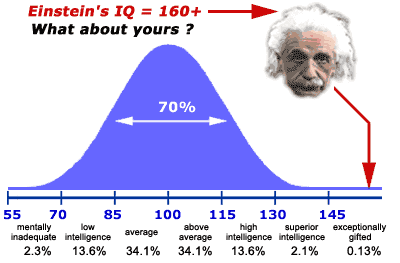
People With Higher IQs Live Longer
 From The Telegraph:
People with higher IQs are more likely to live into healthy old age, according to a study.
Unfortunately, those who do not perform so well in intelligence tests could suffer a higher risk of heart disease, fatal accidents and suicide.
The discovery was made after researchers looked into the medical records of one million Swedish army conscripts.
After taking into account whether they had grown up in a safer, more affluent environment, they established the connection between IQ and mortality.
One of the researchers, Dr David Batty, said the statistics showed "a strong link between cognitive ability and the risk of death."
He added: "People with higher IQ test scores tend to be less likely to smoke or drink alcohol heavily. They also eat better diets, and they are more physically active. So they have a range of better behaviours that may partly explain their lower mortality risk."
Read more ....
Fossil Hunters Find Sea Monster ... And A Dinosaur The Size Of A Skinny Chicken
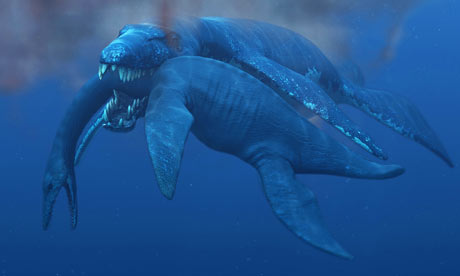 Artist's impression of a 45-tonne Pliosaur attacking a Plesiosaur.
Photograph: Atlantic Productions
From The Guardian:
The giant meat-eating reptile, known as a pliosaur, had a bite four times as powerful as T. rex. The second creature, on the other hand, may be the least scary dinosaur ever discovered.
The remains of a giant meat-eating sea monster that patrolled the oceans during the reign of the dinosaurs have been unearthed on an island in the remote Arctic archipelago of Svalbard.
Norwegian fossil hunters recovered the rear half of the formidable reptile's skull in south-west Spitsbergen in what has been described as one of the most significant Jurassic discoveries ever made.
The predator has been identified as a new species of pliosaur, a group of extinct aquatic reptiles that had huge skulls, short necks and four flippers to power them through the water.
Read more ....
Monday, March 16, 2009
Who Protects The Internet?
 Webmaster: John Rennie and "the Beast" aboard the Wave Sentinel in
the port of Dorset, England Jonathan Worth
From Popsci.com:
Pull up the wrong undersea cable, and the Internet goes dark in Berlin or Dubai. See our animated infographics of how the web works!
For the past five years, John Rennie has braved the towering waves of the North Atlantic Ocean to keep your e-mail coming to you. As chief submersible engineer aboard the Wave Sentinel, part of the fleet operated by U.K.-based undersea installation and maintenance firm Global Marine Systems, Rennie--a congenial, 6'4", 57-year-old Scotsman--patrols the seas, dispatching a remotely operated submarine deep below the surface to repair undersea cables. The cables, thick as fire hoses and packed with fiber optics, run everywhere along the seafloor, ferrying phone and Web traffic from continent to continent at the speed of light.
Read more ....
Quantum Physicist Wins $1.4M Templeton Prize For Writing on “Veiled Reality”
 From Discover:
French physicist Bernard d’Espagnat has won the annual Templeton Prize with its purse of $1.4 million; the prize is often given to scientists who find common ground between religion and science. Professor d’Espagnat, 87, worked with great luminaries of quantum physics but went on to address the philosophical questions that the field poses [BBC News].
Physicists may be more open to seeing a higher power behind the great mysteries of the universe than scientists in other disciplines: Including Dr. d’Espagnat, five of the past 10 Templeton winners have been physicists or have had strong connections to the discipline [The Christian Science Monitor].
Read more ....
Watery Asteroids May Explain Why Life Is 'Left-Handed'
 Image: Amino acids, such as isovaline (illustrated), come in left- and right-handed forms, but almost every living organism on Earth uses left-handed forms. New research suggests that water on asteroids amplified a bias - possibly caused by polarised starlight - towards left-handed amino acids (Illustration: NASA/Mary Pat Hrybyk-Keith)
From New Scientist:
Soggy rocks hurtling through the solar system gave life on Earth an addiction to left-handed proteins, according to a new study. The research suggests that water on asteroids amplified left-handed amino acid molecules, making them dominate over their right-handed mirror images.
Curiously, almost every living organism on Earth uses left-handed amino acids instead of their right-handed counterparts. In the 1990s, scientists found that meteorites contain up to 15% more of the left version too. That suggests space rocks bombarding the early Earth biased its chemistry so that life used left-handed amino acids instead of right.
Read more ....
Botnet Back-Up Gives Glimpse Into Hackers' World
 Photo: Coromandel teen Owen Thor Walker last year admitted to running a botnet that controlled a million computers worldwide. Photo / Alan Gibson
From New Zealand Herald:
SAN FRANCISCO - Getting hacked is like having your computer turn traitor on you, spying on everything you do and shipping your secrets to identity thieves.
Victims don't see where their stolen data end up. But sometimes security researchers do, stumbling across stolen-data troves that offer a glimpse of what identity theft looks like from criminals' perspective.
Researchers from U.K.-based security firm Prevx found one such trove, a website used as a stash house for data from 160,000 infected computers before it was shut down this month.
Read more ....
7 International Spacecraft that Could Replace NASA's Shuttle
 A Chinese rocket carrying the Shenzhou-7 spaceship blasts off from the launch pad at the Jiuquan Satellite Launch Center. (Photo by Xu Haihan/ChinaFotoPress/Getty Images)
 From Popular Mechanics:
NASA's Orion won't be ready until at least 2015, but the current space shuttle is due to retire next year. Meet the seven international spacecraft from the world's space fleet that could inherit the job of ferrying supplies into space.
The space shuttle is due for retirement in 2010, and NASA’s next spaceship, Orion, won’t be available until at least 2015. That will leave a five-year gap during which NASA astronauts and space-station cargo will be grounded unless they find other ways to get to orbit. In the past, NASA has cadged rides off its former arch-rival, the Russian Federal Space Agency, and its Soyuz (for astronauts) and Progress (for cargo) spacecraft. But relations between the U.S. and Russia are cooling, raising the very real prospect that Congress will forbid NASA to buy spaceflights from Russia. NASA has stepped up its support of two U.S. companies, Space Exploration Technologies (SpaceX) and Orbital Sciences Corporation, that hope to have unmanned cargo spaceships ready for launch by 2010. (See details below.) Even if these companies succeed, NASA will still have to rely on Soyuz for manned flights. But maybe not for long. Here’s a roundup of seven rides to low Earth orbit besides the space shuttle and Soyuz that could be available for space-station flights.
Read more ....
Gallery: The Top 10 Failed NASA Missions
 9. Demonstration for Autonomous Rendezvous Technology (DART) Spacecraft : The Mission: Upset with the expense and risk of launching the shuttle every time a satellite needed maintenance, NASA created the DART to show that a robotic satellite could dock with other satellites. DART was supposed to autonomously navigate towards, and then rendezvous with, an existing communications satellite.
The Problem: And did it ever rendezvous! The computer controlling DART incorrectly estimated the distance between the two satellites, causing DART to bump right into the other satellite! DART then used up all of its fuel, eventually crashing into the ocean.
Courtesy of NASA
--------------------------------------------------------------------------------
From Popsci.:
Like no other modern endeavor, the space program inspires all mankind by pushing the edge of the possible. At least, when it works it does. Often, the casual integration of satellite technology into nearly all modern electronics combines with imagery of brave astronauts going forth for all mankind to obscure the basic fact that sending something into space is damn hard, and often fails.
So, inspired by the recent loss of NASA's Orbiting Carbon Observatory satellite, Popsci.com is taking a look back at the Top 10 missions that didn’t slip the surly bonds of Earth, failed to trod the high untrespassed sanctity of space, and most certainly did not touch the face of God.
Read more ....
Trend: Daughters Follow Dads' Footsteps
 From Live Science:
Women nowadays are three times more likely than those born a century ago to do what men have done for millennia — follow their father's footsteps into his line of work, a newly announced study finds.
One way or another, fathers and daughters have been paying more attention to each other, and daughters picked up job cues or assistance from dads, as more and more women entered the labor force, the research suggests.
Just under 6 percent of women born from 1909 to 1915 worked in their father's occupation, while around 20 percent of women born in the mid-1970s do so (they are in their early 30s now), the researchers found.
Read more ....
Anger And Hostility Harmful To The Heart, Especially Among Men
 New research shows that anger and hostility are significantly associated with both a higher risk for coronary heart disease (CHD) in healthy individuals and poorer outcomes in patients with existing heart disease. (Credit: iStockphoto/Vasko Miokovic)
From Science Daily:
ScienceDaily (Mar. 16, 2009) — Anger and hostility are significantly associated with both a higher risk for coronary heart disease (CHD) in healthy individuals and poorer outcomes in patients with existing heart disease, according to the first quantitative review and meta-analysis of related studies, which appears in the March 17, 2009, issue of the Journal of the American College of Cardiology.
Management of anger and hostility may be an important adjuvant strategy in preventing CHD in the general public and treating CHD patients, according to authors.
Read more ....
Sunday, March 15, 2009
Planets Like Earth Appear To Be Out There

From Japan Times:
LONDON — The real wonder of our age is this. You can go on the Web, type in PlanetQuest New Worlds Atlas, or Extrasolar Planets Encyclopedia, or NASA Star and Exoplanet Database, and directly access the data on 340 new planets that have been discovered in the past five years.
That number is set to grow very fast now, for on March 6 The U.S. National Aeronautics and Space Administration (NASA) successfully launched the Kepler telescope, which will find many more planets including potentially Earth-like ones. It will stare unblinkingly at an area of space containing about 100,000 relatively near stars, watching for the tiny dimming of a star that happens when one of its planets passes between the star and us.
Read more ....
After 10 Years, Space Station Finally Nears Completion
 The space shuttle Discovery sits on launch pad 39A at the Kennedy Space Center in Cape Canaveral, Fla. (Scott Audette/REUTERS)
 From Christian Science Monitor:
The Space Shuttle Discovery will bring the last US-made piece to the space station when it launches Wednesday.
A decade ago, the United States docked its first module, Destiny, to an embryonic International Space Station. Tonight, the space shuttle Discovery is set to launch an American segment that could be called “Finally!”
The last major US-built component – a 15.5-ton truss bearing the station’s last set of solar panels – is nestled snuggly in Discovery’s cargo bay, awaiting the orbiter’s launch, now scheduled for Thursday night after Wednesday’s planned launch was scrubbed due to a hydrogen gas leak.
Read more ....
Shuttle Discovery Lifts Off On Mission To ISS -- News Updates March 15, 2009
 The US Space Shuttle Discovery lifts off. Photo AFP
From AFP:
CAPE CANAVERAL (AFP) — The shuttle Discovery has blasted off on a mission to outfit the International Space Station with a final pair of solar wings ahead of the arrival in a few weeks of an expanded space crew.
The spacecraft launched at 7:43 pm (2343 GMT) from the Kennedy Space Center in Florida. Just over eight minutes later, the shuttle entered orbit.
The journey was expected to take two days to reach the ISS, where the seven-member crew was to deliver and install the fourth and final pair of solar wings on the orbiting ISS, in one of the last major tasks of the more than decade-long effort to construct the station.
Read more ....
More News On The Launch Of Discovery
Discovery blasts off into space -- BBC
Successful Launch Starts Shuttle Mission -- Aviation Week
Discovery heads to International Space Station -- Orlando Sentinel
STS-119 Launches into Space…Finally -- The Future Of Things
Discovery blasts off for mission to international space station -- CBC
Space shuttle Discovery reaches orbit successfully -- Scientific American
Space Shuttle Discovery successfully launches after a month of delays -- Wikinews
Backgrounder: Crew members of U.S. space shuttle Discovery's STS-119 mission -- China View
Subscribe to:
Comments (Atom)