A Science News Aggregator That Covers Stories in the World Of Science And Technology.
Monday, December 21, 2009
Winter Solstice 2009: What It's All About
From Christian Science Monitor:
Winter solstice 2009 falls Monday, marking the shortest day in the year for the Northern Hemisphere.
Ah, another winter solstice come and gone.
At 5:47 p.m. Greenwich Mean Time (that's 12:47 p.m. Eastern Standard Time) Monday, the Northern Hemisphere marked the mid-point of another year, as measured by the sun's highest position each day above the horizon. It marked the day with the fewest hours of sunlight this year.
Yes, this is showing a Northern Hemisphere bias. South of the equator, the day marks the most hours of sunlight of the year. So enjoy the austral summer, those of you below the equator. The rest of us? We'll be rooting for longer, warmer days.
Read more ....
World's Oldest Known DNA Discovered
DNA from 419-million-year-old bacteria may have belonged to the descendants ofthe world's first life forms (Source: iStockphoto)
From ABC News (Australia):
It won't make Jurassic Park a reality, but scientists have discovered 419 million-year-old DNA intact inside ancient salt deposits.
The genetic material, the oldest ever found, belongs to salt-loving bacteria whose ancestors may have been among the first life forms on Earth.
Scientists have previously recovered similar genetic material from the Michigan Basin, the same region where the latest discovery was made. But the DNA was so similar to that of modern microbes that many scientists believed the samples had been contaminated.
Not so this time around.
Read more ....
Obama Pledges Billions For Rural Broadband
From The Telegraph:
President Barack Obama has pledged £2 billion in loans and grants to fund the expansion of America’s broadband network to help better serve rural areas and urban communities.
The details of the spending plan were announced last week by Joe Biden, the vice president, and will see an initial $183 million invested in broadband projects in 17 states.
The funding is also expected to create “tens of thousands of jobs”. However, Mr Biden’s chief economist Jared Bernstein could not say precisely how many jobs will emerge, according to a Reuters’ report.
Read more ....
Rethinking Artificial Intelligence
From R&D:The field of artificial-intelligence research (AI), founded more than 50 years ago, seems to many researchers to have spent much of that time wandering in the wilderness, swapping hugely ambitious goals for a relatively modest set of actual accomplishments. Now, some of the pioneers of the field, joined by later generations of thinkers, are gearing up for a massive “do-over” of the whole idea.
Read more ....
Computer Algorithm Identifies Authentic Van Gogh

From Science Daily:
Science Daily (Dec. 21, 2009) — Igor Berezhnoy of Tilburg University in the Netherlands has developed computer algorithms to support art historians and other art experts in their visual assessment of paintings. His digital technology is capable of distinguishing a forgery from an authentic Van Gogh based on the painter's characteristic brush work and use of colour.
Read more ....
The Real Reason Cell Phone Use Is Banned On Airlines

From Live Science:
Airline passengers who sneak in cell phone calls, play with gaming devices or listen to their mp3 players during takeoff or landing probably won't cause a plane crash, but they may risk a confrontation with flight attendants. Federal agencies and airlines typically err on the side of caution — even though researchers and aircraft companies have found almost no direct evidence of cell phones or other electronic devices interfering with aircraft systems.
Read more ....
Yellowstone's Plumbing Exposed
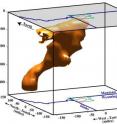
Image: Seismic imaging was used by University of Utah scientists to construct this 3-D picture of the Yellowstone hotspot plume of hot and molten rock that feeds the shallower magma chamber (not shown) beneath Yellowstone National Park, outlined in green at the surface, or top of the illustration. The Yellowstone caldera, or giant volcanic crater, is outlined in red. State boundaries are shown in black. The park, caldera and state boundaries also are projected to the bottom of the picture to better illustrate the plume's tilt. Researchers believe "blobs" of hot rock float off the top of the plume, then rise to recharge the magma chamber located 3.7 miles to 10 miles beneath the surface at Yellowstone. The illustration also shows a region of warm rock extending southwest from near the top of the plume. It represents the eastern Snake River Plain, where the Yellowstone hotspot triggered numerous cataclysmic caldera eruptions before the plume started feeding Yellowstone 2.05 million years ago.From E! Science News:
The most detailed seismic images yet published of the plumbing that feeds the Yellowstone supervolcano shows a plume of hot and molten rock rising at an angle from the northwest at a depth of at least 410 miles, contradicting claims that there is no deep plume, only shallow hot rock moving like slowly boiling soup. A related University of Utah study used gravity measurements to indicate the banana-shaped magma chamber of hot and molten rock a few miles beneath Yellowstone is 20 percent larger than previously believed, so a future cataclysmic eruption could be even larger than thought.
Read more ....
Spitzer’s Cold Look At Space
From American Scientist:To get a clear view of infrared emissions from celestial objects, the Spitzer Space Telescope has been cryogenically cooled—and what sights it has seen.
In astrophysical observations, more is more—imaging across multiple wavelengths leads to richer information. One electromagnetic band in which most celestial bodies radiate is the infrared: Objects ranging in location from the chilly fringes of our Solar System to the dust-enshrouded nuclei of distant galaxies radiate entirely or predominantly in this band. Thus, astrophysicists require good visualization of these wavelengths. The problem, however, is that Earth is a very hostile environment for infrared exploration of space, as the atmosphere also emits in the infrared spectrum and additionally absorbs much of the incoming signal. Even heat produced by a telescope itself can degrade its own clarity.
Read more ....
Labels:
astronomy,
Spitzer Space Telescope
The Physics Of Space Battles
Joseph Shoer is a Ph.D. candidate in aerospace engineering, studying how modular spacecraft could be assembled, and hoping that they will be the telescopes and human exploration vehicles of the future, and not for crushing the dreams of Martian colonists.From Gizmodo:
I had a discussion recently with friends about the various depictions of space combat in science fiction movies, TV shows, and books. We have the fighter-plane engagements of Star Wars, the subdued, two-dimensional naval combat in Star Trek, the Newtonian planes of Battlestar Galactica, the staggeringly furious energy exchanges of the combat wasps in Peter Hamilton's books, and the use of antimatter rocket engines themselves as weapons in other sci-fi. But suppose we get out there, go terraform Mars, and the Martian colonists actually revolt. Or suppose we encounter hostile aliens. How would space combat actually go?
Read more ....
Pictured: Fiery Bubbles Of Molten Lava Fill The Ocean In First Ever Images Of Deep-Sea Volcanic Eruption
Blast: A plume of sulphur and molten lava erupts from the West Mata Volcano nearly 4,000 feet beneath the Pacific Ocean, south of SamoaFrom The Daily Mail:
Scientists have witnessed the eruption of a deep-sea volcano for the first time ever, capturing on video the fiery bubbles of molten lava as they exploded 4,000 feet beneath the surface of the Pacific Ocean.
Researchers are calling it a major geological discovery after a submersible robot witnessed the eruption during an underwater expedition in May near Samoa.
The high-definition videos were revealed yesterday at a geophysics conference in San Francisco.
Read more ....
Beware Humans Bearing Gifts -- A Commentary
From New Scientist:
THERE'S a Latin proverb, per angusta ad augusta, which translates as "through trial to triumph". Literally speaking, "angusta" refers to a narrow passageway. It gives us the English word "anxious", signalling a place that presses against you, where the walls are tight, and you might be too big to get through. Anxiety is the feeling that you might not make it out the other side.
Read more ....
Darker Liquor Makes You Sicker
Overall, bourbon drinkers reported feeling worse than vodka drinkers, rating higher on scales that measure the severity of hangover malaise. Getty ImagesFrom Discover News:
Before heading out to that holiday party this weekend, consider carefully how you pick your poison.
A new study may help drinkers pick their poison. In a head-to-head comparison, bourbon gave drinkers a more severe hangover than vodka, report Damaris Rohsenow of Brown University and colleagues in an upcoming issue of Alcoholism: Clinical and Experimental Research.
Read more ....
Video: Simulation Renders Entire Known Universe
From Popular Science:
Everyone loves a good road movie, whether it's Hope and Crosby or Fonda and Hopper. But the scope of those films pales in comparison to the ground covered by the Hayden Planetarium's new video, The Known Universe. The video starts in Tibet and zooms out through time and space until it shows well, the entire known universe.
Read more ....
Sunday, December 20, 2009
Cannabis Damages Young Brains More Than Originally Thought, Study Finds
Daily consumption of cannabis in teens can cause depression and anxiety, and have an irreversible long-term effect on the brain. (Credit: iStockphoto/Rasmus Rasmussen)From Science Daily:
Science Daily (Dec. 20, 2009) — Canadian teenagers are among the largest consumers of cannabis worldwide. The damaging effects of this illicit drug on young brains are worse than originally thought, according to new research by Dr. Gabriella Gobbi, a psychiatric researcher from the Research Institute of the McGill University Health Centre. The new study, published in Neurobiology of Disease, suggests that daily consumption of cannabis in teens can cause depression and anxiety, and have an irreversible long-term effect on the brain.
Read more ....
Three Station Fliers Set Off On Flight To Lab Complex
From CNET News:
A Russian Soyuz spacecraft carrying three fresh crew members bound for the International Space Station blasted off from the Baikonur Cosmodrome in Kazakhstan early Monday local time, lighting up a cold, pre-dawn sky with a torrent of flame visible for miles around.
With Soyuz commander Oleg Kotov, a station veteran, Japanese astronaut Soichi Noguchi, a shuttle veteran, and rookie astronaut Timothy Creamer strapped into the Soyuz TMA-17 capsule, the rocket roared to life at 4:52 p.m. EST Sunday (3:52 a.m. Monday local time) and quickly climbed away from the same pad used by Yuri Gagarin at the dawn of the space age.
Read more ....
Autism Numbers Are Rising. The Question is Why? Read more
From Time Magazine:
One in 110 American children are considered to fall somewhere along the autism spectrum, according to the latest report released by the federal government. The new figure, which was released initially in October, comes from the most comprehensive set of data yet on the developmental health of eight-year-olds.
Increasing the previous federal estimate of 1 in 150, the new data suggest that 1% of children now exhibit some symptoms of an autism spectrum disorder (ASD), a collection of neurological conditions whose symptoms may range from mild social impairment to more serious communication, language and cognitive deficits. The estimate also represents a stunning 57% increase in prevalence since 2002, when health officials first began a nationwide effort to quantify the risk of autism in childhood.
Read more ....
Chink Found In Armor Of Perfect Cloak
From Science News:
Charged particles could reveal hidden object's location, new idea suggests.
Tiny charged particles could reveal the location of a perfect invisibility cloak. Such a cloak — which exists only in theory at the moment — would render an object invisible by gently deflecting photons around it. But charged particles wouldn’t be fooled: they would interact with the cloak in a telltale way, giving up the cloak’s location, researchers report in a paper to appear in an upcoming Physical Review Letters.
Read more ....
Distance Vision Is All A Blur To More Of Us

From L.A. Times:
A study finds that 17% more Americans have myopia than 30 years ago. Close-up computer work could be a reason.
For an increasing number of Americans, life's a blur.
That's according to a population-based study published Monday showing that rates of myopia -- difficulty seeing distant objects -- are soaring. The trend is matched in many other countries, causing eye doctors to wonder what could be causing the decline in human vision.
Some suspect both an increase in our close-up work time (think computer use) and a decrease in time spent outdoors.
Read more ....
'Google Phone Set For Launch': Videos Emerge Of New Nexus One Mobile Dubbed 'iPhone-Killer'
From The Daily Mail:
Two videos have emerged of Google's first ever phone called Nexus One.
The mobile is still unofficial but reports suggest it will be launched in the New Year in a bid to take on Apple iPhone.
A technology website has released two short teaser clips of the phone in action. The first video showed the animation on the start up screen, incorporating the colours of Google's logo. The second appeared to show an animated wallpaper.
Read more ....
Subscribe to:
Comments (Atom)