A Science News Aggregator That Covers Stories in the World Of Science And Technology.
Thursday, October 29, 2009
Nasa Peers Back Into The 'Cosmic Dark Ages'
From The Independent:
A massive gamma-ray burst 13 billion light years away has thrown new light on the early years of the Universe.
The most distant object ever observed in space has provided scientists with an unprecedented insight into the "cosmic dark ages" following the birth of the Universe some 13.7 billion years ago.
A gigantic explosion on the edge of the known Universe has been confirmed as the furthermost object in the cosmos. It occurred nearly 700 million years after the Big Bang and its radiation has taken some 13 billion years to reach Earth – making it 13 billion light years away.
Read more ....
15 Most Explosive Videos On The Internet
From The Telegraph:
From science experiments to building demolitions to nuclear tests, there are few things in life more visually impressive than explosions. Here are 15 of the most dramatic.
1. Blowing an anvil 200ft into the air. This stunt has scant scientific or educational value, but deserves a prominent place on the list for the presenter's coltish enthusiasm for explosions.
Read more ....
Lucrative Inventions Pit Scientists Against Universities
From USA Today:
Science, that lofty realm of the mind, where thoughts of fortune and financial gain never intrude.
Or do they?
"Oh, you bet it does," says Renee Kaswan of IP Advocate, an Atlanta-based researchers' patent-rights organization. "And it's urgent that someone take the side of researchers in educating them about their rights to their inventions," Kaswan says.
Read more ....
Bad Driving May Have Genetic Basis, Study Finds
Bad drivers may in part have their genes to blame, suggests a new studyby UC Irvine neuroscientists. (Credit: iStockphoto)
From Science Daily:
Science Daily (Oct. 28, 2009) — Bad drivers may in part have their genes to blame, suggests a new study by UC Irvine neuroscientists.
People with a particular gene variant performed more than 20 percent worse on a driving test than people without it -- and a follow-up test a few days later yielded similar results. About 30 percent of Americans have the variant.
"These people make more errors from the get-go, and they forget more of what they learned after time away," said Dr. Steven Cramer, neurology associate professor and senior author of the study published recently in the journal Cerebral Cortex.
Read more ....
40 Years Ago: The Message that Conceived the Internet
From Live Science:On Oct. 29, 1969, UCLA student Charles Kline sent the first message over the ARPANET, the computer network that later became known as the Internet. Though only the "l" and "o" of his message ("login") were successfully transmitted, the interactive exchange ushered in a technological revolution that has — as anyone alive long enough to witness the shift knows — revolutionized human interaction.
Read more ....
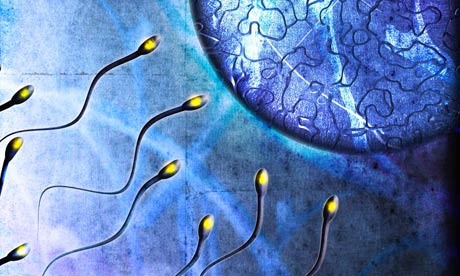
Stem Cell Study Leads To Breakthrough In Understanding Infertility
Understanding the details of how sperm and egg cells grow will help scientists develop treatments. Photograph: CorbisFrom The Guardian:
Hidden stage of human development' is opened up by Stanford University scientists.
Scientists have turned human stem cells into early-stage sperm and eggs in research that promises to give doctors an unprecedented insight into the causes of infertility.
The work will allow researchers to study human reproductive cells from the moment they are created in embryos through to fully-mature sperm and eggs.
Understanding the details of how sperm and egg cells grow will help scientists develop treatments for people who are left infertile when the process goes wrong. The research may also lead to treatments that can correct growth defects before a child is born.
Read more ....
Russian Space Agency Plan To Build NUCLEAR Space Rocket
The Russian Space Agency is using 40-year-old booster rockets to transport astronauts to the International Space Station. Now they plan to go nuclearFrom The Daily Mail:
Russia's space agency is planning to build a new spaceship with a nuclear engine, its chief announced yesterday.
Anatoly Perminov told a government meeting that the preliminary design could be ready by 2012 and would take nine years and cost £363million to build.
'The implementation of this project will allow us to reach a new technological level surpassing foreign developments,' Mr Perminov told a meeting discussing space technologies.
Read more ....
Stellar Blast Is Record-Breaker
From The BBC:
Astronomers have confirmed that an exploding star spotted by Nasa's Swift satellite is the most distant cosmic object to be detected by telescopes.
In the journal Nature, two teams of astronomers report their observations of a gamma-ray burst from a star that died 13.1 billion light-years away.
The massive star died about 630 million years after the Big Bang.
UK astronomer Nial Tanvir described the observation as "a step back in cosmic time".
Professor Tanvir led an international team studying the afterglow of the explosion, using the United Kingdom Infrared Telescope (UKIRT) in Hawaii.
Read more ....
The Root of Thought: What Do Glial Cells Do?
From Scientific American:
Nearly 90 percent of the brain is composed of glial cells, not neurons. Andrew Koob argues that these overlooked cells just might be the source of the imagination.
Andrew Koob received his Ph.D. in neuroscience from Purdue University in 2005, and has held research positions at Dartmouth College, the University of California, San Diego, and the University of Munich, Germany. He's also the author of The Root of Thought, which explores the purpose and function of glial cells, the most abundant cell type in the brain. Mind Matters editor Jonah Lehrer chats with Koob about why glia have been overlooked for centuries, and how new experiments with glial cells shed light on some of the most mysterious aspects of the mind.
Read more ....
Muscle-Bound Computer Interface
Photo: Air guitar: Software interprets signals sent from electromyography sensors attached to a forearm, enabling the user to control computer games such as Guitar Hero and Rock Band. Credit: Microsoft From Technology Review:
Forearm electrodes could enable new forms of hands-free computer interaction.
It's a good time to be communicating with computers. No longer are we constrained by the mouse and keyboard--touch screens and gesture-based controllers are becoming increasingly common. A startup called Emotiv Systems even sells a cap that reads brain activity, allowing the wearer to control a computer game with her thoughts.
Read more ....
Universe's Quantum 'Speed Bumps' No Obstacle For Light
Different wavelengths of light from a distant gamma-ray burst travel at the same speed, down to quantum scales (Illustration: NASA/SkyWorks Digital)From New Scientist:
A hint that quantum fluctuations in the fabric of the universe slow the speed of light has not been borne out in observations by NASA's Fermi telescope. The measurements contradict a 2005 result that supported the idea that space and time are not smooth.
Einstein's theory of special relativity says that all electromagnetic radiation travels through a vacuum at the speed of light. This speed is predicted to be constant, regardless of the energy of the radiation.
Read more ....
Robot Army Could Explore Space, Researchers Say
From Discover Magazine:Instead of spending time and money planning a manned mission to Mars, why not send an army of robots into space to do all the work? A fleet of robots could be deployed to explore far-away planets, according to researchers at Caltech’s Visual and Autonomous Exploration Systems Research Laboratory.
From the Telegraph:
Robotic airships and satellites will fly above the surface of the distant world, commanding squadrons of wheeled rovers and floating robot boats…The systems will transform planetary exploration, says [Wolfgang] Fink, who envisages the cybernetic adventurers mapping the land and seascapes of Saturn’s moon, Titan—believed to have lakes of standing liquid—as well as closer planetary neighbors like Mars.
Read more ....
How California's New Water Laws Inform the Coming National Crisis
An old tire lies on a dry stretch of the San Joaquin River below Gravelly Ford, near Mendota in Fresno County. (Photograph by Michael Macor/The Chronicle) From Popular Mechanics:
California has its share of problems these days; the state carries billions of dollars in debt, drug cartels have made their way in from Mexico and the wild fire season came and went with great force. As if the governor didn't have enough on his plate, California is also in the midst of one of the biggest water crises this nation has ever seen. Farmers and fishing communities, businesses and a growing population are locked in a battle over water rights—scrambling for what has become a dwindling resource. To stop the problem, a task force has studied the Sacramento–San Joaquin River Delta for two years and came up with dozens of proposals to alleviate the water crisis. Here are six of the most prescient proposed items—problems and solutions that may be coming to a local assembly (or a courthouse) near you.
Read more ....
Wednesday, October 28, 2009
Globalization: Diseases Spreading From Humans To Animals, Study Finds
Staphylococcus aureus.(Credit: Agricultural Research Service / United States Department of Agriculture)
From Science Daily:
Science Daily (Oct. 28, 2009) — Globalisation and industrialisation are causing diseases to spread from humans to animals, a study has shown.
Researchers from The Roslin Institute of the University of Edinburgh have shown that a strain of bacteria has jumped from humans to chickens.
It is believed to be the first clear evidence of bacterial pathogens crossing over from humans to animals and then spreading since animals were first domesticated some 10,000 years ago.
Read more ....
Why Halloween Terrifies Some Kids
About one out of every 100 kids suffers from phobia of costumed characters. Typically, the fear is rooted in a sense that some harm or danger is going to come from this thing they do not understand. Image credit: stockxpertFrom Live Science:
The pitter-patter of little feet running from door to door this Halloween, dressed to the nines in their creepiest costumes sounds, like good old-fashioned fun.
But for some kids, the ghosts, goblins and witches are more terrifying than many adults realize. While mild fear of some costumed character, say Santa Claus, is normal for kids, extreme fears that keep children from going trick-or-treating or to a party at Chuck E. Cheese's, where the man-size mouse could give them a fright, are called phobias.
Read more ....
Labels:
children,
interesting story,
psychology
Fastest Supercomputer in the World Models Dark Matter, HIV Family Tree Simultaneously
From Popular Science:
Petaflop power in action.
In November of last year, scientists at Los Alamos National Laboratory switched on Roadrunner, the world's fastest computer. IBM and the Department of Energy built the machine to model nuclear explosions, but two new studies, both released today, are proof that the computer's massive power has been at least as devoted to peaceful science as to simulating thermonuclear weapons.
Read more ....
Detecting Life-Friendly Moons
The astronaut Buzz Aldrin inhabiting the moon on July 20, 1969,during the Apollo 11 mission. Credit: NASA
From Astrobiology Magazine:
Forty years ago, the Apollo astronauts traipsed across our Moon, making it "inhabited" for the first time – albeit for only two and half hours. A bona-fide habitable moon has never been found, but astronomers are considering how we might find one around distant stars.
"I think exomoons are just as interesting as exoplanets," says David Kipping of University College London.
Read more ....
Astronomical Artifact: Most Distant Object Yet Detected Carries Clues From Early Universe
A false-color image from the Gemini North Telescope in Hawaii shows the afterglow of GRB 090423 [circled], the most distant astronomical event yet observed. Gemini Observatory/NSF/AURA, D. Fox and A. Cucchiara (Penn State University) and E. Berger (Harvard University)From Scientific American:
A stellar explosion spotted in April took place 13 billion years ago.
A violent explosion picked up by a NASA satellite earlier this year is the oldest object ever seen by astronomers, its light having been emitted some 13 billion years ago. At that time the universe was roughly 5 percent of its present age and the big bang was a fairly recent occurrence, having taken place just 600 million years earlier.
NASA's Swift Gamma-Ray Burst spacecraft spotted the flash signaling a massive stellar explosion on April 23. The explosion was officially designated GRB 090423, after its type (a gamma-ray burst) and date of detection; the space agency quickly announced it as the new record holder for cosmic distance. Now, two papers in the October 29 Nature present detailed analyses of the burst and afterglow, confirming the initial distance assessments and providing a few clues as to conditions in the early universe.
Read more ....
High-Energy Batteries Coming To Market
Photo: Battery unpacked: This graphic illustrates the multilayered structure of a ReVolt rechargeable zinc-air battery. From top to bottom: the battery cover, which lets in air; a porous air electrode; the interface between electrodes; the zinc electrode; the casing. Credit: ReVolt From Technology Review:
Rechargeable zinc-air batteries can store three times the energy of a lithium-ion battery.
A Swiss company says it has developed rechargeable zinc-air batteries that can store three times the energy of lithium ion batteries, by volume, while costing only half as much. ReVolt, of Staefa, Switzerland, plans to sell small "button cell" batteries for hearing aids starting next year and to incorporate its technology into ever larger batteries, introducing cell-phone and electric bicycle batteries in the next few years. It is also starting to develop large-format batteries for electric vehicles.
Read more ....
Swine Flu: Eight Myths That Could Endanger Your Life
From New Scientist:
The second wave of the swine flu pandemic is now under way in the northern hemisphere. Case numbers are climbing fast and in some places vaccination has begun.
So what's the big deal? The virus hasn't evolved into the monster that some feared and most cases are mild. Were all those pandemic warnings just scare-mongering?
Perhaps, but the Butcher family of Southampton, UK, wouldn't say so. In August, their daughter Madelynne, 18, became sick and short of breath after returning from a holiday. Two weeks later, she died in hospital.
Read more ....
Subscribe to:
Comments (Atom)