Monday, October 27, 2008

Scientists Take Drugs To Boost Brain Power: Study

(Photo from Pet-Comfort)

From Breitbart/AFP:

Twenty percent of scientists admit to using performance-enhancing prescription drugs for non-medical reasons, according to a survey released Wednesday by Nature, Britain's top science journal.

The overwhelming majority of these med-taking brainiacs said they indulged in order to "improve concentration," and 60 percent said they did so on a daily or weekly basis.

The 1,427 respondents -- most of them in the United States -- completed an informal, online survey posted on the "Nature Network" Web forum, a discussion site for scientists operated by the Nature Publishing Group.

More than a third said that they would feel pressure to give their children such drugs if they knew other kids at school were also taking them.

"These are academics working in scientific institutions," Ruth Francis, who handles press relations for the group, told AFP.

Read more ....

Sunday, October 26, 2008

Depressed Astronauts Might Get Computerized Solace

Dartmouth psychologist Dr. Mark Hegel poses in his office with his laptop in Lebanon, N.H., Friday, Oct. 17, 2008. Hegel is working on a computer program, "The Virtual Space Station," that will guide astronauts through treatment for depression and other problems while in space. (AP Photo/Jim Cole)

From Myway:

BOSTON (AP) - Your work is dangerous and your co-workers rely on you to stay alive. But you can never get far from those colleagues. You can't see your family for months, even years. The food isn't great. And forget stepping out for some fresh air.

No wonder the adventure of space flight can also be stressful, isolating and depressing. So scientists are working on giving a computer the ability to offer some of the understanding guidance - if not all the warmth - of a human therapist, before psychological problems or interpersonal conflicts compromise a mission.

Clinical tests on the four-year, $1.74 million project for NASA, called the Virtual Space Station, are expected to begin in the Boston area by next month.

The new program is nothing like science fiction's infamous HAL, the onboard artificial intelligence that goes awry in "2001: A Space Odyssey." The Virtual Space Station's interaction between astronaut and computer is far less sophisticated and far more benevolent.

Read more ....

Study: Humans Almost Became Extinct 70,000 Years Ago -- FOX News

From FOX News:

WASHINGTON — Human beings may have had a brush with extinction about 70,000 years ago, an extensive genetic study suggests.

The human population at that time had been gradually reduced to small isolated groups across eastern and southern Africa, apparently because of massive droughts lasting tens of thousands of years, according to an analysis released Thursday.

The report notes that a separate study by researchers at Stanford University estimated the number of early humans may have shrunk as low as 2,000 before numbers began to rapidly expand again in the period known as the Late Stone Age.

Read more ....

Cure For The Common Cold?

Colds are caused by a virus and can occur year-round. The common cold generally involves a runny nose, nasal congestion, and sneezing. Other symptoms include sore throat, cough, and headache. A cold usually lasts about 7 days, with perhaps a few lingering symptoms such as a cough for another week. (Photo from Medline Plus)

Hope For Common Cold Treatment -- The Telegraph

Hopes for a treatment for common cold have been raised after scientists discovered how it causes symptoms such as sneezing and a runny nose.

The characteristic effects of a cold are not brought about directly by the virus but by its ability to turn the body's own defences against itself, scientists have found.

Up to half of common colds are caused by various strains of the human rhinovirus and new research has shown the bug triggers a domino effect where the body's own defences over-react causing the familiar symptoms.

The findings could result in treatments for common colds caused by rhinovirus which strike hundreds of thousands of people each year in the UK.

Current treatments only work on allievating the symptoms rather than tackling the cause of the cold.

A team at the University of Calgary, in Canada, took samples from the noses of 35 volunteers, 17 of whom had been infected with a rhinovirus.

Read more ....

NASA unveils new lunar rover built for endurance

A photographer stands next to a new lunar rover vehicle that U.S. space agency NASA is testing in Black Point, Arizona, October 24, 2008. The Small Pressurized Rover Concept vehicle is designed to carry two astronauts without space suits, sitting in a pressurized compartment, when NASA returns to lunar exploration by 2020. The vehicle is being tested in a remote corner of Arizona with similar surface conditions to those found on the moon. It has a range of up to 625 miles (1,000 km). REUTERS/Tim Gaynor (UNITED STATES)

From Reuters:

BLACK POINT, Arizona (Reuters) - NASA unveiled a new lunar rover on Friday which aims to transform space exploration by allowing astronauts to roam large distances without cumbersome spacesuits when they return to the moon by 2020.

A team of scientists is testing the Small Pressurized Rover Concept vehicle -- which resembles a small, futuristic recreational vehicle mounted on six sets of wheels -- 12 in all -- in trials in a rocky, barren corner of northern Arizona, selected for its similarities to the surface of the moon.

"This is the next generation of lunar exploration," said Doug Craig, NASA program's manager, as an astronaut took the vehicle for a spin over a broad lava field framed by craggy mountains.

The battery powered rover travels at speeds of up to 6 mph. It is part of a range of systems and equipment being developed by the space agency for its planned return to the moon over the next decade.

NASA hopes to build a permanent manned base on the moon's surface as a prelude to subsequent exploration missions to Mars.

Read more ....

The Physics of Whipped Cream

From NASA:

Let's do a little science experiment. If you have a can of whipped cream in the fridge, go get it out. Spray a generous dollop into a spoon and watch carefully.

Notice anything interesting? The whipped cream just did something rather puzzling. First it flowed smoothly out of the nozzle like a liquid would, and then, a moment later, it perched rigidly in the spoon as if it were solid. What made it change?

(While you're pondering this question, insert spoon into mouth, in the name of science.)

Whipped cream performs this rapid changing act because of a phenomenon called "shear thinning." When part of the foam is forced to slide or "shear" past the rest of the foam, the foam "thins." It becomes less like honey and more like water, allowing it to flow easily until the shearing stops.

Shear thinning occurs in many substances--e.g., ketchup, blood, motor oil, paint, liquid polymers such as molten plastic--and it is often crucial to how a substance is used. For instance, excessive shear thinning of motor oil is unwanted because it reduces the oil's ability to protect engines from wear, while shear thinning of paint allows it to flow smoothly from the brush but stay put on the wall. It also allows ketchup to flow from the bottle but not drip off your french fries.

Read more ....

Internet Mysteries: How Much File Sharing Traffic Travels the Net? -- Update

Internet traffic an ordinary day visualised with Arc Map, a 3D software developed by Stephen G. Eick at Bell Laboratories-Lucent technologies.

From Wired:

How much of the traffic on the internet is peer-to-peer file trading?

Everyone seems to agree it represents a lot of the traffic, but the truth is no one knows (with the possible exception of the ISPs and backbone providers in the middle, and they aren't telling or sharing raw data).

One of the most recent reports on P2P traffic came from a traffic optimization firm called Ellacoya in June 2007. Their report said that http-based web traffic had overtaken peer-to-peer traffic on the net, thanks to streaming media sites like YouTube.

Ellacoya, since acquired by Arbor Networks for its traffic-shaping technology, pegged http traffic at 46 percent of the net's volume, with P2P traffic close by at 37 percent.The company says the data was based on about 1 million North American broadband subscribers.

Read more ....

The Shirt That Sums Up Wikipedia


Hat Tip Gizmodo.

Catching Up On Sleep

Can You Catch Up On Lost Sleep? -- Scientific American

Let's do some sleep math. You lost two hours of sleep every night last week because of a big project due on Friday. On Saturday and Sunday, you slept in, getting four extra hours. Come Monday morning, you were feeling so bright-eyed, you only had one cup of coffee, instead of your usual two. But don't be duped by your apparent vim and vigor: You're still carrying around a heavy load of sleepiness, or what experts call "sleep debt"—in this case something like six hours, almost a full nights' sleep.

Sleep debt is the difference between the amount of sleep you should be getting and the amount you actually get. It's a deficit that grows every time we skim some extra minutes off our nightly slumber. "People accumulate sleep debt surreptitiously," says psychiatrist William C. Dement, founder of the Stanford University Sleep Clinic. Studies show that such short-term sleep deprivation leads to a foggy brain, worsened vision, impaired driving, and trouble remembering. Long-term effects include obesity, insulin resistance, and heart disease. And most Americans suffer from chronic deprivation.

Read more ....

Saturday, October 25, 2008

10 Optical Illusions In 2 Minutes

Stunning Pictures And Photos

(Photo from Smashing Magazine)

From Smashing Magazine:

Photography is a very powerful medium and a very difficult craft. Excellent photos don’t only display some facts — they tell stories, awake feelings and manage to share with the audience the emotions a photographer experienced when clicking the shot button. Taking excellent pictures is damn hard as you need to find a perfect perspective and consider the perfect timing. To achieve brilliant photography you need practice and patience. However, it is worth it: the results can be truly stunning.

Below you’ll find 50 brilliant photos and stunning pictures — some pictures tell stories, some are incredibly beautiful, some are funny and some are very sad.

Read more ....

Astronomers Witness Supernova's First Moments

ONE IN 10,000: Astronomers caught a lucky break when a pair of supernovae exploded in spiral galaxy NGC 2770 within a few weeks of each other. While studying the first explosion, SN 2007uy, they caught the second supernova, SN 2008D, in real-time. NASA / Swift Science Team/ Stefan Immler

From The Scientific American:

Lucky catch supports long-standing view of supernova shock wave

Astronomers have observed for the first time the thunderclap of x-rays that announces a star has exploded into a supernova. Researchers monitoring spiral galaxy NGC 2770, approximately 88 million light-years away, observed a brief but intense flash of x-rays in early January, followed by a prolonged afterglow of visible and ultraviolet light—the hallmark of a supernova.

Although the x-ray outburst lasted only seven minutes, it flashed 100 billion times brighter than the sun in that time. Based on that brightness and the duration of the flash, researchers conclude that the star (SN 2008D) was approximately 20 times the size of the sun and was blown apart by a shock wave expanding outward at 70 percent the speed of light.

Writing in Nature, the group says the discovery offers the first direct evidence for astrophysical models of supernova shock waves that date to the 1970s.

Read more ....

The History Of Hangovers

(Photo from The New York Times)

A Few Too Many -- The New Yorker

Is there any hope for the hung over?

Of the miseries regularly inflicted on humankind, some are so minor and yet, while they last, so painful that one wonders how, after all this time, a remedy cannot have been found. If scientists do not have a cure for cancer, that makes sense. But the common cold, the menstrual cramp? The hangover is another condition of this kind. It is a preventable malady: don’t drink. Nevertheless, people throughout time have found what seemed to them good reason for recourse to alcohol. One attraction is alcohol’s power to disinhibit—to allow us, at last, to tell off our neighbor or make an improper suggestion to his wife. Alcohol may also persuade us that we have found the truth about life, a comforting experience rarely available in the sober hour. Through the lens of alcohol, the world seems nicer. (“I drink to make other people interesting,” the theatre critic George Jean Nathan used to say.) For all these reasons, drinking cheers people up. See Proverbs 31:6-7: “Give . . . wine unto those that be of heavy hearts. Let him drink, and forget his poverty, and remember his misery no more.” It works, but then, in the morning, a new misery presents itself.

Read more ....

Leg Up

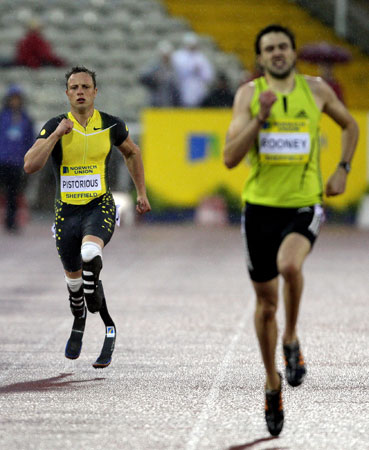
Oscar Pistorius of South Africa (L) chases Martyn Rooney of Great Britain. (Photo from Slate)

From Slate:

The emerging supremacy of artificial limbs.

Oscar Pistorius was born with defective legs. Before his first birthday, they were amputated below the knee. That didn't stop him. Now 21, he has broken three world track records for disabled athletes and is racing to qualify for the 400 meters at this summer's Olympics. If he can shave four-tenths of a second off his best time, he'll make it.

How has he done it? One answer is superhuman grit. The other is superhuman legs. Pistorius runs on carbon-fiber prostheses made for sprinting. In January, the International Association of Athletics Federations declared them ineligible, claiming they were better than human legs. But on Friday, the Court of Arbitration for Sport overturned that decision, clearing his path to the Olympics.

Go, Oscar, go. We're all rooting for you to cross that finish line in Beijing. Just one note of caution: Don't win.

Read more ....

What Happens To Your Web Stuff When You Die?

Will your photos and websites live on after you've gone? (Image from Techradar.com)

From TechRadar.com:

Ensure your profiles and pics stay up if you pop your clogs

Technology can do many wonderful things, but sadly it can't stop the Grim Reaper - so what happens to your web posts when you die? Will your photos, blogs and websites still be around for your grandchildren to read, or will your online presence disappear when you do?

The law is clear enough, as Struan Robertson, Legal Director with Pinsent Masons and Editor of OUT-LAW.com explains. "You can bequeath your copyright to others," he says. "So I can say in my will that I'm leaving all my rights in my photographs or website to a friend. If I don't do that, the copyright will belong to my estate - and in most cases it will survive for 70 years after my death."

Your estate may own the copyright, but that doesn't mean your stuff will stay online. "In most cases contracts will terminate with your death," Robertson says, "although it can depend on the terms of the contract."

Read more ....

Planets Thought Dead Might Be Habitable

(Image From National Geographic)

From Live Science:

Astronomers have long talked about a "habitable zone" around a star as being a confined and predictable region where temperatures were not to cold, not to hot, so that a planet could retain liquid water and therefore support life as we know it.

The zone may not be so fixed, it turns out. Some extrasolar planets that one might assume are too cold to host life could in fact be made habitable by a squishing effect from their stars, a new study found.

A planet's midsection gets stretched out by its star's gravity so that its shape is slightly more like a cigar than a sphere. Some planets travel non-circular, or elongated paths around their stars. As such a world moves closer to the star, it stretches more, and when it moves farther away, the stretching decreases.

Read more ....

Scientists Fixing Hubble Contend With Antiquated Computers

This full-size mock up of the Hubble Space Telescope's computer system, is where NASA astronauts train before going up to work on the telescope, and where Goddard Space Flight Center scientists test their theories about how to fix Hubble. (Photograph courtesy of NASA)

From Popular Mechanics:

NASA scientists trying to find out what went wrong during last week's repair of the Hubble Space Telescope find themselves dealing with 486 processors and other outdated computer technology. But sometimes, mission managers say, simple is good when you're out in space—as long as you know how to talk to decades-old computers.

The Hubble needs service—again. The space telescope has beamed gorgeous images of the universe down to Earth for 17 years and has undergone four servicing missions by space shuttles. A September 27 failure in the Science Data Formatter pushed back a planned fifth and final servicing mission aboard the space shuttle Atlantis from this month until February 2009. While trying to switch over some of the telescope's electrical systems to redundant backup versions remotely, the team at NASA's Goddard Space Flight Center in Maryland hit two anomalies that caused the telescope to enter "safe mode" and stop most science operations. Goddard scientists think they have found the cause, and hope that operations will resume this weekend. But perhaps finding a few problems should come as no surprise—not only have Hubble's backup systems sat idle for 18 years, but the telescope operates with computer systems long outdated here on Earth.

Read more ....

Friday, October 24, 2008

Out of Thin Air: How Money is Really Made

Newer bills cary security threads, color-shifting ink and watermarks. None of that insures the money will grow, however. For that, you need lots of lending and even more faith.

From Live Science:

Making money in 2008 looks like a grim proposition, but not because U.S. government printing presses can't create enough dollar bills.

The U.S. Bureau of Engraving and Printing (whose web site name perhaps says it all: moneyfactory.gov) churns out about 38 million bills of varying denominations daily, all worth $750 million in face value. Facilities in Fort Worth, Texas and Washington D.C. use 18 tons of ink per day to keep up.

Yet 95 percent of fresh notes simply replace those already in circulation. Common $1 bills last about 21 months, while a $100 bill can go for roughly 7.4 years before requiring replacement. Taken all together, these physical bills represent just a drop in the bucket of global money.

Read more ....

Drought Resistance Is The Goal, But Methods Differ

Jacqueline Heard directs Monsanto's program for drought-tolerant crops at its research center in Mystic, Connecticut. (Wendy Carlson for The New York Times )

From International Herald Tribune:

GRAND ISLAND, Nebraska: To satisfy the world's growing demand for food, scientists are trying to pull off a genetic trick that nature itself has had trouble accomplishing in millions of years of evolution. They want to create varieties of corn, wheat and other crops that can thrive with little water.

As the world's population expands and global warming alters weather patterns, water shortages are expected to hold back efforts to grow more food. People drink only a quart or two of water every day, but the food they eat in a typical day, including plants and meat, requires 2,000 to 3,000 quarts to produce.

For companies that manage to get "more crop per drop," the payoff could be huge, and scientists at many of the biggest agricultural companies are busy tweaking plant genes in search of the winning formula.

Read more ....

Computer Circuit Built From Brain Cells

Image Is From Reading Eagle

From New Scientist Tech:

For all its sophistication and power, your brain is built from unreliable components – one neuron can successfully provoke a signal in another only 40% of the time.

This lack of efficiency frustrates neuroengineers trying to build networks of brain cells to interface with electronics or repair damaged nervous systems.

Our brains combine neurons into heavily connected groups to unite their 40% reliability into a much more reliable whole.

Now human engineers working with neurons in the lab have achieved the same trick: building reliable digital logic gates that perform like those inside electronics.
Built from scratch

Elisha Moses at the Weizmann Institute of Science in Rehovot, Israel, and his students Ofer Feinerman and Assaf Rotem have developed a way to control the growth pattern of neurons to build reliable circuits that use neurons rather than wires.

The starting point is a glass plate coated with cell-repellent material. The desired circuit pattern is scratched into this coating and then coated with a cell-friendly adhesive. Unable to gain purchase on most of the plate, the cells are forced to grow in the scratched areas.

The scratched paths are thin enough to force the neurons to grow along them in one direction only, forming straight wire-like connections around the circuit.

Using this method the researchers built a device that acts like an AND logic gate, producing an output only when it receives two inputs.

Read more ....