Saturday, October 25, 2008

Scientists Fixing Hubble Contend With Antiquated Computers

This full-size mock up of the Hubble Space Telescope's computer system, is where NASA astronauts train before going up to work on the telescope, and where Goddard Space Flight Center scientists test their theories about how to fix Hubble. (Photograph courtesy of NASA)

From Popular Mechanics:

NASA scientists trying to find out what went wrong during last week's repair of the Hubble Space Telescope find themselves dealing with 486 processors and other outdated computer technology. But sometimes, mission managers say, simple is good when you're out in space—as long as you know how to talk to decades-old computers.

The Hubble needs service—again. The space telescope has beamed gorgeous images of the universe down to Earth for 17 years and has undergone four servicing missions by space shuttles. A September 27 failure in the Science Data Formatter pushed back a planned fifth and final servicing mission aboard the space shuttle Atlantis from this month until February 2009. While trying to switch over some of the telescope's electrical systems to redundant backup versions remotely, the team at NASA's Goddard Space Flight Center in Maryland hit two anomalies that caused the telescope to enter "safe mode" and stop most science operations. Goddard scientists think they have found the cause, and hope that operations will resume this weekend. But perhaps finding a few problems should come as no surprise—not only have Hubble's backup systems sat idle for 18 years, but the telescope operates with computer systems long outdated here on Earth.

Read more ....

Friday, October 24, 2008

Out of Thin Air: How Money is Really Made

Newer bills cary security threads, color-shifting ink and watermarks. None of that insures the money will grow, however. For that, you need lots of lending and even more faith.

From Live Science:

Making money in 2008 looks like a grim proposition, but not because U.S. government printing presses can't create enough dollar bills.

The U.S. Bureau of Engraving and Printing (whose web site name perhaps says it all: moneyfactory.gov) churns out about 38 million bills of varying denominations daily, all worth $750 million in face value. Facilities in Fort Worth, Texas and Washington D.C. use 18 tons of ink per day to keep up.

Yet 95 percent of fresh notes simply replace those already in circulation. Common $1 bills last about 21 months, while a $100 bill can go for roughly 7.4 years before requiring replacement. Taken all together, these physical bills represent just a drop in the bucket of global money.

Read more ....

Drought Resistance Is The Goal, But Methods Differ

Jacqueline Heard directs Monsanto's program for drought-tolerant crops at its research center in Mystic, Connecticut. (Wendy Carlson for The New York Times )

From International Herald Tribune:

GRAND ISLAND, Nebraska: To satisfy the world's growing demand for food, scientists are trying to pull off a genetic trick that nature itself has had trouble accomplishing in millions of years of evolution. They want to create varieties of corn, wheat and other crops that can thrive with little water.

As the world's population expands and global warming alters weather patterns, water shortages are expected to hold back efforts to grow more food. People drink only a quart or two of water every day, but the food they eat in a typical day, including plants and meat, requires 2,000 to 3,000 quarts to produce.

For companies that manage to get "more crop per drop," the payoff could be huge, and scientists at many of the biggest agricultural companies are busy tweaking plant genes in search of the winning formula.

Read more ....

Computer Circuit Built From Brain Cells

Image Is From Reading Eagle

From New Scientist Tech:

For all its sophistication and power, your brain is built from unreliable components – one neuron can successfully provoke a signal in another only 40% of the time.

This lack of efficiency frustrates neuroengineers trying to build networks of brain cells to interface with electronics or repair damaged nervous systems.

Our brains combine neurons into heavily connected groups to unite their 40% reliability into a much more reliable whole.

Now human engineers working with neurons in the lab have achieved the same trick: building reliable digital logic gates that perform like those inside electronics.
Built from scratch

Elisha Moses at the Weizmann Institute of Science in Rehovot, Israel, and his students Ofer Feinerman and Assaf Rotem have developed a way to control the growth pattern of neurons to build reliable circuits that use neurons rather than wires.

The starting point is a glass plate coated with cell-repellent material. The desired circuit pattern is scratched into this coating and then coated with a cell-friendly adhesive. Unable to gain purchase on most of the plate, the cells are forced to grow in the scratched areas.

The scratched paths are thin enough to force the neurons to grow along them in one direction only, forming straight wire-like connections around the circuit.

Using this method the researchers built a device that acts like an AND logic gate, producing an output only when it receives two inputs.

Read more ....

Giant Spider Eating A Bird Caught On Camera

From The Telegraph:

Photographs of a giant spider eating a bird in an Australian garden have stunned wildlife experts.

The pictures show the spider with its long black legs wrapped around the body of a dead bird suspended in its web.

The startling images were reportedly taken in Atheron, close to Queensland's tropical north.

Despite their unlikely subject matter, the pictures appear to be real.

Joel Shakespeare, head spider keeper at the Australian Reptile Park, said the spider was a Golden Orb Weaver.

"Normally they prey on large insects… it's unusual to see one eating a bird," he told ninemsn.com.

Mr Shakepeare said he had seen Golden Orb Weaver spiders as big as a human hand but the northern species in tropical areas were known to grow larger.

Queensland Museum identified the bird as a native finch called the Chestnut-breasted Mannikin.

Read more ....

New Earthbound Telescopes Will Be Hundreds of Times Sharper Than Hubble

Smart Starlight: The Hubble Space Telescope sees a star as a blob (simulated, left), but MROI will be able to see features on the surface. Star spots (simulated, right) can indicate a star’s age because they are caused by magnetic activity that ebbs as a star gets older.

From Popular Mechanics:

One mountaintop telescope may not be able to do it alone, but a new array of telescopes under construction in the New Mexico desert will offer never-before-seen cosmic vistas.

On a 10,500-ft.-high mountaintop above the New Mexico desert, construction has begun on a $45 million array of telescopes that will reveal enlightening details of stars and black holes. The Magdalena Ridge Observatory Interferometer (MROI), named for its mountaintop perch, will capture distant light in as many as 10 movable 1.4-meter (about 4 1/2-ft.) telescopes. When these light beams are combined, they will create images that will be hundreds of times sharper than those of the Hubble Space Telescope, according to Chethan Parameswariah, the lead electronics engineer on the project. MROI’s ability to capture images of natural processes that before had only been measured indirectly will provide insight into the formation of planets, the life cycle of stars and patterns of radioactive cosmic dust. The first two telescopes will arrive in 2010; researchers hope to start observations by 2012.

Read more ....

"Gladiator" Tomb Discovered In Rome


From The CBS:

Archaeologists Uncover Mausoleum Belonging To Roman General Who Inspired Oscar-Winning Epic

(CBS/AP) The tomb of a rich Roman general, believed to be the inspiration for the main character of the Oscar-winning movie "Gladiator," has been found on the outskirts of Rome.

Ongoing construction work along the northbound Via Flaminia uncovered the remains of a mausoleum that archaeologists believe to be at least fifteen yards long.

An inscription among the remains gives reason to believe that the tomb belongs to a patrician known as Marcus Nonius Macrinus, a proconsul who achieved major victories for Marcus Aurelius, emperor from 161 AD until his death in 180 AD.

Macrinus, a favorite of the emperor, is thought to have been the inspiration for the writers of the 2000 Ridley Scott film when imagining the character played by Russell Crowe in the award-winning epic.

Senior archaeologist Daniela Rossi of Rome's Superintendency for Archaeology said inscriptions indicate the tomb belonged to Macrinus, a well-known figure from a family from Brescia in northern Italy. Rossi said Macrinus had a unique resume: "Police commissioner, magistrate, proconsul of Asia, and committees of the Emperor. He was very close to Marcus Aurelius who wanted him in the war against the Marcomanni," a Germanic tribe.

Read more ....

The World's Top 10 Worst Pollution Problems


From Scientific American:

From the residue of mining to untreated sewage, the world is grappling with a host of environmental problems.

The "I Trust My Legs" gold mine in Ghana is a local affair, where miners shift silt from rudimentary pits and then combine it with mercury. The element (a toxic metal that can cause brain damage) captures all the gold in the dirt and then, when the mixture is heated, dissipates into the air, leaving just gold bits behind. Unfortunately, in what is known as artisanal mining, the mercury also enters the lungs of miners, their families and others nearby. The United Nations Industrial Development Organization (UNIDO) estimates that some 15 million miners, their families and neighbors (including 4.5 million women and 600,000 children) are affected by the fumes, which are known to cause brain damage and even death.

Such gold mining is just one of world's most pressing global pollution problems, according to the Blacksmith Institute, an environmental health group based in New York City. Among the others: air pollution in homes from cooking, industrial smog in cities, untreated sewage, metal smelting and the recycling of lead (which causes brain damage) from old batteries.

Read more ....

Science On The 'Fringe'

From Live Science:

FRINGE takes viewers on a wild ride using sciences that traditionally lie on the "fringe" of mainstream science, such as mind control or teleportation. But with so much research being done in these fields, many of the show’s ideas are actually ripped from science magazines and journals.

"We start by finding ideas right out of the headlines from a science magazine or the announcement for new research grant and we think, 'what is the next step or how can we push the boundaries?'" said Whitman. "For example, in episode three one of the characters was receiving messages in his brain telepathically and the Monday before the show aired, we saw an article on the CNN website that explained how the U.S. Army was developing a helmet that uses brain waves to help soldiers talk to each other."

Whitman and Chiappetta are "media consultants," not scientists, and while they’ve been advisors on several TV shows, they note their expertise comes from curiosity and researching science journals and the popular press, not formal training. Chiappetta has a law degree from the University of Texas, and Whitman has his PhD in economics from New York University.

Read more ....

Thursday, October 23, 2008

Brain Starts To Slow Down At 40

From The Telegraph:

Life does not begin at 40 - it just slows down.

According to the latest research, our brain is fastest at 39 and afterwards, it declines "at an accelerating rate." That means that reactions also slow, claim the researchers.

The loss of a fatty skin that coats the nerve cells, called neurons, during middle age causes the slowdown, experts say.

The coating acts as insulation, similar to the plastic covering on an electrical cable, and allows for fast bursts of signals around the body and brain.

When the sheath deteriorates, signals passing along the neurons in the brain slow down. This means reaction times in the body are slower too.

Scientists at the University of California, Los Angeles, say that after 40 the body "loses the battle" to repair the protective sheaths.

The finding was made after researchers tested how quickly men aged from 23 to 80 could tap their index fingers in ten seconds.

Read more ....

Pictured: Stunning Images Of Spiral Galaxy 50Million Light Years Away

Diffuse clouds made up from dust and complex organic molecules can be seen in the long-range images of NGC 7331 (Image from the Daily Mail)

From The Daily Mail Online:

It can usually only be seen as a faint fuzzy spot through the average telescope, but these stunning images show just how magnificent the spiral galaxy NGC 7331 can be.

The galaxy is around 50million light years away in the northern constellation, Pegasus, and is similar in size to our own 'Milky Way' galaxy.

The long-exposure photographs were taken with a LAICA camera (Large Area Imager) by the Calar Alto Observatory, based in southern Spain, who attached a camera to a 3.5m telescope to capture the impressive shots.

The outstanding spiral structure of NGC 7331 is seen shining behind a number of stars belonging to our galaxy the Milky Way, and in front of a rich background populated by an overwhelming variety of distant galaxies.

A thin haze of the ghostly, fuzzy and dusty nebulae known as galactic cirrus is visible. The diffuse clouds are made up from dust, complex organic molecules and gas.

NGC 7331 was discovered by the astronomer Wilhelm Herschel in 1784. The sharpness of the images are believed to represent the deepest view of the region to date.

Read more ....

Chinese Angry Over Microsoft Anti-Piracy Tool

From MSNBC/Reuters:

Program turns computer screen black if installed software fails validation

BEIJING - Chinese Internet users have expressed fury at Microsoft's launch of an anti-piracy tool targeting Chinese computer users to ensure they buy genuine software.

The "Windows Genuine Advantage" program, which turns the user's screen black if the installed software fails a validation test, is Microsoft's latest weapon in its war on piracy in China, where the vast majority of 200 million computer users are believed to be using counterfeit software, unwittingly or not.

"Why is Microsoft automatically connected with my computer? The computer is mine!" one angry blogger wrote on popular Chinese web portal Sina.com. "Microsoft has no right to control my hardware without my agreement."

Another blogger railed over the cost of authorized versions.

"If the price of genuine software was lower than the fake one, who would buy the fake one?" he wrote.

Read more ....

McGill Physicists Find A New State Of Matter In A 'Transistor'

A replica of the first working transistor. (Image Wikimedia)

From E! Science News:

McGill University researchers have discovered a new state of matter, a quasi-three- dimensional electron crystal, in a material very much like those used in the fabrication of modern transistors. This discovery could have momentous implications for the development of new electronic devices. Currently, the number of transistors that can be inexpensively crammed onto a single computer chip increases exponentially, doubling approximately every two years, a trend known as Moore's Law. But there are limits, experts say. As chips get smaller and smaller, scientists expect that the bizarre laws and behaviours of quantum physics will take over, making ever-smaller chips impossible.

This discovery, and other similar efforts, could help the electronics industry once traditional manufacturing techniques approach these quantum limits over the next decade or so, the researchers said. Working with one of the purest semiconductor materials ever made, they discovered the quasi-three-dimensional electron crystal in a device cooled at ultra-low temperatures roughly 100 times colder than intergalactic space. The material was then exposed to the most powerful continuous magnetic fields generated on Earth. Their results were published in the October issue of the journal Nature Physics.

Read more ....

Space Programs Poised for Major Expansion in Asia

From National Defense Magazine:

SAPPORO, Japan — Japan’s government is about to kick off a major expansion of the nation’s space programs. The goal is to broaden the scope of space research from traditional areas such as exploration into new military and commercial applications.

The intent is to boost the country’s space industry and, over time, become less dependent on foreign suppliers such as the United States.

“There was a huge inferiority complex for the Japanese industry, that we needed to catch up with the top-level, state-of-the-art technology,” says Hokkaido University associate professor Kazuto Suzuki.

These goals would have been unrealistic until Japan’s legislature passed a law that for the first time creates a dedicated space bureau — run by a controversial politician, Seiko Noda.

“They knew they had to change their space law and their space organization because they were not structured and organized in order to compete in the 21st century,” says Vincent Sabathier, senior fellow and director of space initiatives at the Center for Strategic and International Studies in Washington.

The Japanese government beginning in the 1970s invested 4 trillion yen into research and development projects, including satellites, rockets, launchers, exploration spacecraft, and most recently, Kibo, the experimental module that was installed aboard the International Space Station this summer.

Read more ....

Do Five Simple Things A Day To Stay Sane, Say Scientists

From Times Online:

Simple activities such as gardening or mending a bicycle can protect mental health and help people to lead more fulfilled and productive lives, a panel of scientists has found.

A “five-a-day” programme of social and personal activities can improve mental wellbeing, much as eating fruit and vegetables enhances physical health, according to Foresight, the government think-tank. Its Mental Capital and Wellbeing report, which was compiled by more than 400 scientists, proposes a campaign modelled on the nutrition initiative, to encourage behaviour that will make people feel better about themselves.

People should try to connect with others, to be active, to take notice of their surroundings, to keep learning and to give to their neighbours and communities, the document says.

Its advice to “take notice” includes suggestions such as “catch sight of the beautiful” and “savour the moment, whether walking to work, eating lunch or talking to friends”. Examples of learning include mending a bike or trying to play a musical instrument.

Read more ....

California Is Due for a Katrina-Style Disaster

(Click to Enlarge)
Image from Wired Science

From Wired Science:

When the next big earthquake hits the San Francisco Bay Area, it will be a catastrophe of Hurricane Katrina proportions. Hundreds, perhaps thousands of people will die, and hundreds of thousands will become homeless. Economic losses will be on the order of $200 billion, the vast majority of it uninsured. Outside help will be desperately needed, but difficult to coordinate and execute.

And just as before Hurricane Katrina, scientists have been sounding the alarm, warning that the disaster is inevitable. It's not a matter of if, but when the "Big One" will strike.

"The reality is that we could have a large earthquake at any time," said geologist David Schwartz of the U.S. Geological Survey.

The Bay Area is lined with faults capable of delivering a knock-out blow. But one in particular is poised to rupture sooner than later. Geologists have determined that the average time between major earthquakes on the Hayward fault is 140 years. The last big one was October 21, 140 years ago.

Read more ....

Invention: Hurricane Pacifier

Releasing smoke particles into the lower reaches of a hurricane can shift energy to its periphery and reduce the severity of the storm, say the authors of a new patent application (Image: WIPO)

From New Scientist Tech:

Interest in hurricane mitigation has peaked since Hurricane Katrina devastated New Orleans in 2005, and any means of limiting the damage wrought by these huge storms would be welcomed by governments and vulnerable populations alike.

Now an Israeli team says it has developed a way to take the sting out of the storms. Their new patent application says seeding hurricanes with smoke particles could lower wind speeds enough to mitigate their destructive potential.

A hurricane's destructive potential is proportionally related to the strongest winds inside it, and only a small reduction in wind speed is needed to dramatically reduce the damage it causes.

Hurricanes derive their immense power from warm waters on the surface of the sea. As the water evaporates, it rises into the hurricane and eventually condenses and falls as rain, releasing its latent heat energy as it does so – a process known as "heat cycling".

Daniel Rosenfeld and colleagues at the Hebrew University of Jerusalem say injecting smoke into the lower parts of a hurricane causes water vapour to condense at a lower altitude than usual, and form droplets that are too small to fall as rain.

Read more ....

Wednesday, October 22, 2008

Sizing Up The Earth

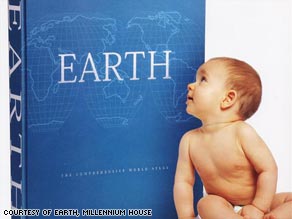
"Earth" is the largest atlas ever produced and weighs over 30 kilos. (Image from CNN)

From CNN:


LONDON, England (CNN) -- It is being billed as the ultimate book about the world and it is something of a landmark in its own right. "Earth" -- the biggest atlas ever to be published -- promises to be a luxurious benchmark in cartography.

Created by Millennium House, "Earth" -- complete with a clam shell case -- measures 610 x 469 millimeters and weighs in at over 30 kilos.

The price is pretty hefty too. The leather bound, gilt-edged book will set you back around $3500.

Its existence owns much, if not all, to the perseverance of Australian businessman Gordon Cheers who has been dreaming of creating such a book for over 20 years.

Cheers, who has spent much of his working life at some of the world's major publishing houses, couldn't convince his various employers to take the project on. Penguin said no. So did Random House.

Undeterred, Cheers decided to start his own company, Millennium House, which produces a wide range of high quality reference books.

Read more ....

It Was Very Warm In The Artic 6000-7000 Years Ago

Settlement: Astrid Lyså in August 2007 in the ruined settlement left by the Independence I Culture in North Greenland. The first immigrants to these inhospitable regions succumbed to the elements nearly 4000 years ago, when the climate became colder again. (Credit: Eiliv Larsen, NGU)

Less Ice In Arctic Ocean 6000-7000 Years Ago
-- Science Daily


ScienceDaily (Oct. 20, 2008) — Recent mapping of a number of raised beach ridges on the north coast of Greenland suggests that the ice cover in the Arctic Ocean was greatly reduced some 6000-7000 years ago. The Arctic Ocean may have been periodically ice free.

”The climate in the northern regions has never been milder since the last Ice Age than it was about 6000-7000 years ago. We still don’t know whether the Arctic Ocean was completely ice free, but there was more open water in the area north of Greenland than there is today,” says Astrid LysÃ¥, a geologist and researcher at the Geological Survey of Norway (NGU).

Read more ....

Google Invests In Preventing Disease

Electron micrograph of the bird flu virus. Google is funding an initiative to spot dangerous pathogens that leap from animals to humans. Image: Corbis

Pandemics: Google Takes On Real Viruses -- The Guardian

The search giant Google has pledged to fund research aimed at detecting and preventing virulent new diseases

Google has pledged to try to stop the next global pandemic by investing $15m in a series of hi-tech health schemes.

Money from the internet giant will provide funding for six projects that aim to detect new diseases and understand the conditions that help them spread – potentially saving millions of lives in the process.

"Business as usual won't prevent the next Aids or Sars," said Dr Larry Brilliant, the executive director of Google.org. "The teams we're funding today are on the frontiers of digital and genetic early-detection technology."

Read more ....