Image: University of Abertay Dundee/Scottish Police Services Authority)
Fingerprints On Fabrics Could Now Solve Crimes -- New Scientist
Picture the scene: a body is found dead after falling from a high balcony. As forensics teams gather at the scene they need to understand whether it was an accident or something more sinister. Now, the dead man's shirt might hold the answer.
Are Tablets Going To Kill The PC? -- Discovery Magazine
It would've been more appropriate to call this year's Consumer Electronics Show (CES) in Las Vegas the Consumer Tablet Show.
In the wake of Apple’s iPad 2010 success with sales topping 10 million units, competing companies rolled out more than 80 tablet devices at the January electronics tradeshow.
“At CES, it seemed like every major company introduced at least one new tablet to its line of products,” said Jonathan Strickland, technology expert who covered CES 2011 for HowStuffWorks.com and the TechStuff podcast.
My Comment: I am skeptical that this will happen. Computers are easier to use .... and quicker when it comes to work. Tablets will be predominant .... but killing the PC .... nah.
Photo: Holy Mole-y The Verisante Aura uses Raman spectroscopy to analyze moles and other skin growths for the presence of malignant cells nearly instantaneously, taking some of the guesswork out of melanoma diagnosis. Verisante Technology
New Handheld Melanoma Scanner Instantly Identifies Skin Cancers With Laser Light -- Popular Science
Yeah, you’ve been thinking about getting that thing checked out, but it’s just a mole right? Such is the problem with melanoma; it’s tough to know which spots on the skin are benign and which could be the hallmark of early-stage skin cancer. Most dermatologists still decide which moles require a biopsy by good old fashioned eye-balling, but a new device developed by researchers at British Colombia Cancer Agency (BCCA) could remove that guesswork, using a handheld laser to quickly identify problem spots that require closer examination.
City Tech student Thinh LĂȘ with the apparatus he built to measure the optical transmission of meteorite samples. (Credit: Michele Forsten)
Asteroid Deflection: What If A Huge Asteroid Was Going To Slam Into Earth? -- Science Daily
ScienceDaily (Jan. 31, 2011) — So you think global warming is a big problem? What could happen if a 25-million-ton chunk of rock slammed into Earth? When something similar happened 65 million years ago, the dinosaurs and other forms of life were wiped out.
"A collision with an object of this size traveling at an estimated 30,000 to 40,000 mile per hour would be catastrophic," according to NASA researcher and New York City College of Technology (City Tech) Associate Professor of Physics Gregory L. Matloff. His recommendation? "Either destroy the object or alter its trajectory."
Photo: First Lt. Travis Gilbert, 34, center, enjoys his first beer since returning from a yearlong deployment in Afghanistan. Anita Powell / S&S
For Veterans, Road to Mental Health May Begin at the Bar -- Live Science
Connecting struggling veterans to the mental health services they need is an ongoing challenge. Now, a new study finds that the process could start with a sympathetic bartender.
The exploratory study found that bartenders at Veterans of Foreign Wars (VFW) clubs could help identify veterans in trouble and direct them to mental health professionals. Brief and inexpensive training for these bartenders would widen the safety net for veterans in need of care, said study researcher Keith Anderson, a professor of social work at Ohio State University
Read more .... My Comment: I do not see many soldiers disagreeing with this course of treatment.
How Egypt Pulled The Plug On The Internet -- CBS News
Within Six Minutes, Internet Providers for 93 Percent of Egypt Went Down - And Have Not Come Back.
(CBS) NEW YORK - The uprising in Egypt is a quintessential 21st century event - born on Facebook and other social networking sites - which led the government to cut off Internet service.
Science and Technology correspondent Daniel Sieberg reports on this desperate effort to keep a lid on dissent.
The Internet blackout was a surprising move for a nation previously known for being open - compared to other countries in the Mideast.
My Comment: A Microsoft browser security flaw .... how come I am not surprised. What will really make the news, is when they report that there are no security flaws.
The UN has warned of a global hunger crisis over predicted poor crop yields. Photo by wordpress.com
2.4 Billion Extra People, No More Land: How Will We Feed The World In 2050? -- The Independent
Steve Connor reveals how scientists propose a major policy shift to tackle one of the great challenges of the 21st century.
The finite resources of the Earth will be be stretched as never before in the coming 40 years because of the unprecedented challenge of feeding the world in 2050, leading scientists have concluded in a report to be published next week.
Food production will have to increase by between 70 and 100 per cent, while the area of land given over to agriculture will remain static, or even decrease as a result of land degradation and climate change. Meanwhile the global population is expected to rise from 6.8 billion at present to about 9.2 billion by mid-century.
My Comment: If not .... what has been happening in Tunisia and Egypt in the past two weeks will be a piper when compared to what may happen in the future when the populations involved are 50% greater.
Vikings' Crystal Clear Method Of Navigation -- New Scientist
Viking sagas may have been more truthful than we realised. Crystal "sunstones" could have helped Viking sailors to navigate even when cloud or fog hid the sun.
Vikings navigated using sundials calibrated to show the direction of the North Pole. While there is no physical evidence for the navigational techniques adopted on cloudy days, there are references in the Viking sagas to "sunstones" being used.
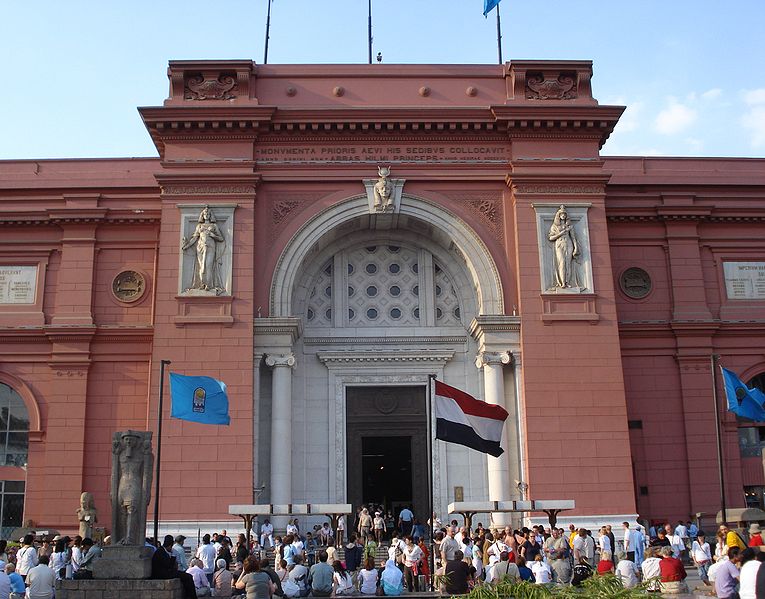
Photo: The Egyptian Museum (Courtesy Kristoferb/Wikimedia Commons)
Egypt's Treasures: Assessing The Damage -- Discover Magazine
Concern about Egypt’s priceless antiquities continues to grow, and Egyptologists around the world are issuing high-alert statements about the risk of Egyptian antiquities being smuggled abroad.
“It would be a wonderful gesture if people who are in the antiquity business do not buy any Egyptian artifact at the moment, particularly if they look Old Kingdom antiquities or if they appear to come from the Memphite Necropolis of the New Kingdom,” Salima Ikram, professor of Egyptology at the American University in Cairo, told Discovery News in a phone interview from Cairo.
Greenland Ice Sheet Is Safer Than Scientists Previously Thought -- The Guardian
New study overturns fears that increased melting could lubricate the ice sheet, causing it to sink ever faster into the sea.
The threat of the Greenland ice sheet slipping ever faster into the sea because of warmer summers has been ruled out by a scientific study.
Until now, it was thought that increased melting could lubricate the ice sheet, causing it to sink ever faster into the sea. The issue was a key unknown in the landmark 2007 report from the Intergovernmental Panel on Climate Change, which pinned the blame for climate change firmly on greenhouse gas emissions from human activities.
Never Stop Sweating Jetportal is Jeffrey Montes on Flickr
FYI: How Much Can A Human Body Sweat Before It Runs Out? -- Popular Science
It all depends on the size, physical fitness and hydration of the person in question, but it’s possible to sweat buckets before heatstroke sets in and we pass out. After all, there are about three million sweat glands on the human body (the highest concentration is on our palms), and the average person aggressively working out perspires about 0.7 to 1.5 liters per hour. Theoretically, if we were attached to a treadmill and pumped full of liquids, it’s possible to keep sweating forever.
My Comment: The sentence that caught my attention was the following ..... .... During the Ironman Hawaii, competitors perspire some 15 liters (about four gallons) throughout the combined marathon run, 2.4-mile swim and 112-mile bike ride.
Mark E. Kelly at a news conference in Tucson this month, joined by Dr. Peter Rhee, one of Gabrielle Giffords’s doctors. Joshua Lott/Reuters
Giffords’s Husband Faces Decision on Shuttle Flight -- New York Times
As Representative Gabrielle Giffords settles into a rehabilitation hospital in Houston, a major question remains for her husband, the astronaut Mark E. Kelly: Will he fly or not?
Captain Kelly, a Navy officer who flew 39 combat missions in the Persian Gulf war, is scheduled to fly the shuttle Endeavour on a two-week mission to the International Space Station in April.
With his wife at the beginning of a long and arduous rehabilitation program to recover from a gunshot wound to the head, Captain Kelly and his bosses at NASA will have to determine whether he can maintain the training regimen in the weeks leading up to the launching and command the mission.
Expedition 26 crew: (from left to right) Engineers Oleg Skripochka, Alexander Kaleri, Dmitry Kondratyev, Paolo Nespoli, Catherine Coleman and Commander Scott Kelly
Happy Birthday! Commander Of International Space Station Crew Has Present Delivered By Unmanned Rocket -- The Daily Mail
The commander of a six-person crew who are currently on the International Space Station (ISS) has had a special delivery today, Russian Mission Control have confirmed.
The unmanned rocket delivered food, fuel, oxygen, scientific equipment and packages for the U.S.-Russian-Italian crew, who are part of Nasa's Expedition 26.
And commander Scott Kelly, leading the trip which began in November, found a surprise package to help him celebrate when he turns 47 on February 21.
Will Google Survive Facebook? -- Wall Street Journal
"How can we not be happy?" Google CFO Patrick Pichette asked rhetorically last week as the Internet search giant unveiled stellar earnings and revenue for the fourth quarter and full year 2010.
He got his answer: a swift $25 drop in Google's stock price. Shares closed Friday at $600.99.
On the face of it, Google management and shareholders had plenty to celebrate. In the fourth quarter, sales surged 26%, while profits rose 29%—both above Wall Street's expectations. Growth in Google's core search business accelerated, and Mr. Pichette stressed that newer businesses in display and mobile search were "another growth engine" for the company. Analysts rushed to increase their one-year stock-price targets, with some going as high as $800.
This is a digital model showing how molybdenite can be integrated into a transistor. (Credit: Credit: EPFL)
New Transistors: An Alternative to Silicon and Better Than Graphene -- Science Daily
ScienceDaily (Jan. 30, 2011) — Smaller and more energy-efficient electronic chips could be made using molybdenite. In an article appearing online January 30 in the journal Nature Nanotechnology, EPFL's Laboratory of Nanoscale Electronics and Structures (LANES) publishes a study showing that this material has distinct advantages over traditional silicon or graphene for use in electronics applications.
Looters Damage King Tut Artifacts in Egypt -- Live Science
As chaos reportedly ensues on the streets of Cairo, the Egyptian Museum became a piece of property for looters to exploit, according to Zahi Hawass, secretary general of the Supreme Council of Antiquities.
About 1,000 people jumped over the wall on the eastern side of the museum on Friday (Jan. 28) when the protests began. They raided the gift shop, thinking it was the museum, according to Hawass's blog. Ten of the individuals made their way into the museum.
After Egypt, Will U.S. Get 'Internet Kill Switch'? -- PC Magazine
With reports of Egypt's government completing shutting down the Internet in the country, talk about an "Internet kill switch" bill in the U.S. has reemerged. Could it happen here?
The bill in question is the Protecting Cyberspace as a National Asset Act of 2010, a cyber-security measure introduced in June by Sen. Joseph Lieberman. It was an over-arching cyber-security measure that, among other things, would create an office of cyberspace policy within the White House and a new cyber-security center within the Homeland Security Department.
One theory suggests that the Great Pyramid had been built inside-out using an internal spiral ramp, as opposed to an external ramp as had long been suggested. Corbis
Great Pyramid May Hold Two Hidden Chambers -- Discovery News
A 3-D simulation of the 4,500-year-old structure suggests an ancient secret lies beneath the desert sand.
* Two secret chamber housing funereal furniture were discovered at the Great Pyramid of Giza. * The furniture was intended for use in the afterlife by the pharaoh Khufu, also known as Cheops in Greek.