Friday, February 26, 2010

Under Fire, Administrator Defends NASA’s New Direction

From The New York Times:

WASHINGTON — Maj. Gen. Charles F. Bolden Jr., the administrator of the National Aeronautics and Space Administration, faced skeptical, sometimes hostile questioning on Thursday from members of a key House committee who said they opposed the Obama administration’s plans to revamp the nation’s human spaceflight program.

General Bolden told the Committee on Science and Technology that the president’s $19 billion budget proposal for NASA — which would cancel the agency’s program to send astronauts back to the Moon, invest in new space technologies and turn to commercial companies for transportation beyond low-Earth orbit — would provide a “more affordable and more sustainable” approach to space exploration.

Read more ....

Space Pioneer Burt Rutan Blasts NASA Plan

From The Wall Street Journal:

Commercial space pioneer Burt Rutan has sharply criticized Obama administration proposals to outsource key portions of NASA's manned space program to private firms.

The White House wants NASA to use outside firms to develop and operate new rockets and spacecraft that would transport astronauts into orbit and beyond, functions that had previously been considered a core function of the agency. Mr. Rutan, a veteran aerospace designer and entrepreneur, in a letter addressed to lawmakers on Capitol Hill, says he is "fearful that the commercial guys will fail" to deliver on the promises to get beyond low earth orbit, and that the policy risks setting back the nation's space program.

Read more ....

Italian Court Convicts Google Execs Over Video

From The San Francisco Chronicle:

In a case that could have broad implications for Internet use around the world, an Italian court convicted three Google Inc. executives Wednesday of criminal charges for failing to quickly remove an uploaded video.

Officials at the Mountain View company pledged to appeal, saying if the verdict is allowed to stand, "the Web as we know it will cease to exist."

Legal experts agreed the case raises troubling questions for all U.S. Internet companies that do business globally.

Read more ....

Band of Bots: Two Military Robots Team Up To Cover Land and Air


From Popular Mechanics:

In war, teamwork is everything, even if you're a robot. Just as human soldiers and airmen support each other, teams of robots will likely roam future battlefields, helping each other on missions.

Read more ....

Chinese Scientists Would Feel "Blind" If Google Pulled Out


From Popular Science:

Scientists don't want to see Google go bai bai.

Most Chinese citizens may still rely on homegrown Baidu for their Internet search needs, but Google's threatened pullout apparently worries the vast majority of Chinese scientists surveyed by the journal Nature. "If I lose Google, it will [be] just like a man without his eyes," one respondent said.

Read more ....

Google Hit With Antitrust Complaints In Europe

Photo: The European Union Commission is located in Brussels, Belgium. Photo courtesy Wikimedia.

From Epicenter:

The European Commission has acknowledged receipt of three antitrust complaints against Google. It did not identify the companies and said it had not started a formal investigation.

“The Commission can confirm that it has received three complaints against Google which it is examining. The Commission has not opened a formal investigation for the time being,” an unidentified E.U. executive said in a statement on Wednesday.

Read more ....

New All-In-One Space Weather Tool From NASA


From Watts Up With That?:

The press release doesn’t contain any pictures, and really doesn’t do this new web tool justice, so I’ve added some screencaps. In a nutshell, the new iSWA site lets you arrange graphical packages of solar images and plots oncsreen for simultaneous evaluation. Stuff that had been scattered over several solar related websites is now in one interface. Pretty cool. – Anthony

Read more ....

Thursday, February 25, 2010

Physicists Discover Odd Fluctuating Magnetic Waves

Brown University physicist Vesna Mitrovic and colleagues have discovered magnetic waves that fluctuate when exposed to certain conditions in a superconducting material. The find may help scientists understand more fully the relationship between magnetism and superconductivity. (Credit: Lauren Brennan/Brown University)

From Science Daily:

Science Daily (Feb. 24, 2010) — At the quantum level, the forces of magnetism and superconductivity exist in an uneasy relationship. Superconducting materials repel a magnetic field, so to create a superconducting current, the magnetic forces must be strong enough to overcome the natural repulsion and penetrate the body of the superconductor. But there's a limit: Apply too much magnetic force, and the superconductor's capability is destroyed.

Read more ....

Heaviest Element Officially Named Copernicium

From Live Science:

The heaviest element yet known is now officially named "Copernicium," after the astronomer Nicolaus Copernicus.

Copernicum has the atomic number 112 — this number denotes the number of protons in the nucleus of an atom. It is 277 times heavier than hydrogen, making it the heaviest element officially recognized by international union for chemistry IUPAC.

Read more ....

Wireless Speed Freaks Set To Leave Wi-Fi Standing

Wi-Fi is so pedestrian. Gi-Fi anyone? (Image: Sipa Press/Rex Features)

From New Scientist:

WI-FI as we know it is reaching the limits of its usefulness. It just can't keep up with our appetite for services, such as new video formats, that gobble up bandwidth. So what's next in the world of blisteringly fast home-based wireless technologies?

For clues to where Wi-Fi is going, it helps to delve into the soup of standards that will shape the future of wireless communications.

Read more ....

Larger Threat Is Seen In Google Case

Bill Echikson, a spokesman for Google, called a judge's ruling against executives “astonishing.” Paolo Bona/Reuters

From The New York Times:

ROME — Three Google executives were convicted of violating Italian privacy laws on Wednesday, the first case to hold the company’s executives criminally responsible for the content posted on its system.

The verdict, though subject to appeal, could have sweeping implications worldwide for Internet freedom: It suggests that Google is not simply a tool for its users, as it contends, but is effectively no different from any other media company, like newspapers or television, that provides content and could be regulated.

Read more ....

One In 10 Teenagers Fall Victim To Cyberbullies, Research Finds

One in 10 children has fallen victim to cyberbullies, research shows Photo: GETTY

From The Telegraph:

One in 10 teenagers has been a victim of cyberbullies, according to university research.

The internet means that they can be targeted round-the-clock, researchers warned.

Experts claim that cyberbullying can be more damaging than conventional teasing because perpetrators can remain anonymous and therefore make more hurtful claims.

Read more ....

Why Millions Of Consumers Are Breaking The Law When They Use Their iPod

Photo: Law breaker? Millions of consumers transfer albums to MP3 players

From The Daily Mail:

Copying your favourite CD on to your iPod has become a routine part of modern life for music lovers.

But millions of consumers are unaware they are breaking the law every time they transfer an album or a DVD to their MP3 player or home computer – despite having purchased both legitimately.

Now, the threat of prosecution could be lifted after a customer body called for copyright laws to be updated for the technological age.

Read more ....

Autonomous Submarine 'Bot Plans Experiments, Navigates Without Human Help

One of MBARIs Automatic Underwater Vehicles Gulper is a high-tech update to this earlier-generation sister research vessel, which was used for seafloor mapping. Monterey Bay Aquarium Research Institute

From Popular Science:

Researchers at the Monterey Bay Aquarium Research Institute are done spending valuable time heading out to sea on routine monitoring missions, and they have the autonomous underwater robot to prove it. A team of marine researchers there has developed what they are calling the Gulper automatic underwater vehicle (AUV) that operates autonomously far out to sea, planning its own experiments and negotiating ocean depths without human input.

Read more ....

Is The Bloom Energy Server Cost, Scale Prohibitive?


From Channel Web:

The unveiling of the Bloom Energy Server, a power generating device that lets home and business users meet their own electricity needs with clean energy while taking them off of the power grid, was met with great fanfare this week.

But solution providers say the $700,000 to $800,000 price tag along with its ability to generate 100 kilowatts of electricity could make it a difficult sell.

"The price point I believe is going to be the difficult thing," said Darryl Parker, CEO of Parker Web Services, a North Carolina solution provider.

Read more ....

America’s Wind Energy Potential Triples In New Estimate


From Wired Science:

The amount of wind power that theoretically could be generated in the United States tripled in the newest assessment of the nation’s wind resources.

Current wind technology deployed in nonenvironmentally protected areas could generate 37,000,000 gigawatt-hours of electricity per year, according to the new analysis conducted by the National Renewable Energy Laboratory and consulting firm AWS Truewind. The last comprehensive estimate came out in 1993, when Pacific Northwest National Laboratory pegged the wind energy potential of the United States at 10,777,000 gigawatt-hours.

Read more ....

The Great Filament


From Watts Up With That?

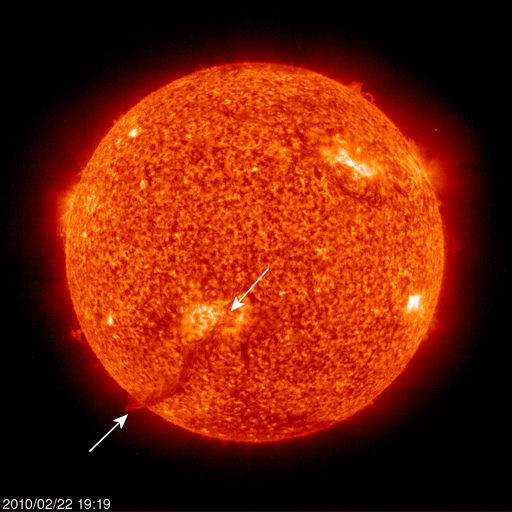
The Solar and Heliospheric Observatory (SOHO) is tracking an enormous magnetic filament on the sun. It stretches more than one million kilometers from end to end, which makes it an easy target for backyard solar telescopes. For the seventh day in a row, an enormous magnetic filament is hanging suspended above the surface of the sun’s southern hemisphere. The Solar and Heliospheric Observatory (SOHO) has a great view. How long can it last? Solar filaments are unpredictable. If this one collapses and hits the stellar surface, the impact could produce a powerful Hyder flare.

Read more ....

Amazing Facts And Figures About The Evolution Of Hard Disk Drives

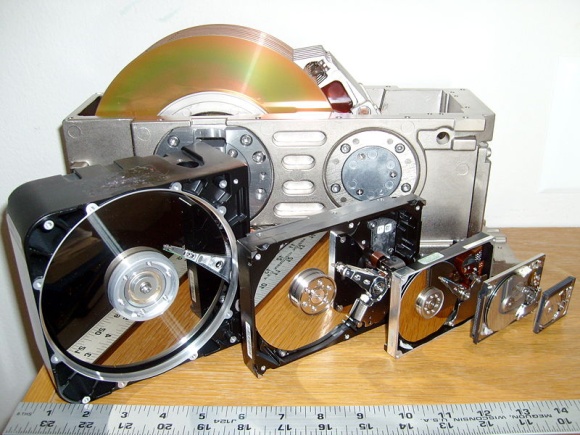
Above: Three decades of shrinkage.

From Pingdom:

It took 51 years before hard disk drives reached the size of 1 TB (terabyte, i.e. 1,000 GB). This happened in 2007. In 2009, the first hard drive with 2 TB of storage arrived. So while it took 51 years to reach the first terabyte, it took just two years to reach the second.

This article looks back at how hard disk drives have evolved since they first burst onto the scene in 1956. We’ll examine the radical changes over time for three different aspects of HDDs: Size, storage space, and price.

Read more ....

Genetic Link Between Misery and Death Discovered; Novel Strategy Probes 'Genetic Haystack'

Interaction between nerves (red) and tumor cells (blue) in an ovary provides one way by which stress biochemistry signals can be distributed to sites of disease in the body. (Credit: Image courtesy of University of California - Los Angeles)

From Science Daily:

Science Daily (Feb. 25, 2010) — In ongoing work to identify how genes interact with social environments to impact human health, UCLA researchers have discovered what they describe as a biochemical link between misery and death. In addition, they found a specific genetic variation in some individuals that seems to disconnect that link, rendering them more biologically resilient in the face of adversity.

Read more ....

Brain's 'Fairness' Spot Found

Humans tend not to like unequal situations, and now scientists have found the first evidence that this behavior is reflected in the human brain. Here, an fMRI scan of a human brain showing activity in the striatum and prefrontal cortex, regions of the brain thought to be involved in how people evaluate rewards. Credit: Elizabeth Tricomi, Rutgers University.

From Live Science:

At some point in our lives, we've all cried "It's not fair!" In fact, it's human nature for us to dislike unequal situations, and we often try to avoid or remedy them. Now, scientists have identified the first evidence of this behavior's neurological underpinnings in the human brain.

The results show that the brain's reward center responds to unequal situations involving money in a way that indicates people prefer a level playing field, and may suggest why we care about the circumstances of others in the first place.

Read more ....