A Science News Aggregator That Covers Stories in the World Of Science And Technology.
Thursday, January 14, 2010
The Devastating Haiti Earthquake: Questions And Answers
From Live Science:
The earthquake that devastated Haiti Tuesday was the strongest temblor to hit the island nation in more than 200 years. The magnitude 7.0 quake caused tremendous damage that officials have yet to fully characterize, and the death toll may run into the thousands.
What caused the Haiti earthquake, and why was it so devastating? Here are answers to these and other questions:
Read more ....
The Exoplanet Explosion
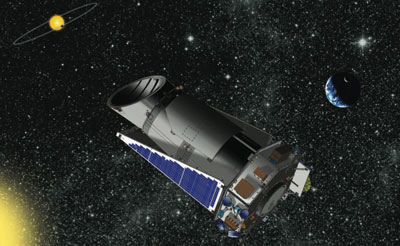
The first six weeks of scientific data returned by Kepler has already turned up five exoplanets, with many more candidates waiting to be studied. (credit: NASA)From The Space Review:
Fifteen years ago, there were virtually no known planets beyond the (then nine) planets in our own solar system: just a few found by chance orbiting a pulsar. Then, in late 1995 and 1996, came the initial discovery of planets orbiting main sequence stars like the Sun. That slow trickle of discoveries became a steady stream as astronomers refined their instruments and techniques, as well as increased both the number of stars studied and their period of time observed. By the beginning of 2010 astronomers reported finding over 400 such extrasolar planets, or exoplanets.
Read more ....
Cocaine Found In Shuttle Work Area, NASA Says
Workers align the space shuttle Discovery's thrusters in Orbiter Processing Facility Bay 3 at NASA's Kennedy Space Center in December 2009. A small amount of cocaine was found in a restricted area of the facility on Wednesday, NASA said. NASAFrom MSNBC/Space.com:
NASA says workers face drug tests; no impact on flights expected.
NASA is investigating how a small amount of cocaine ended up in a space shuttle hangar at the agency's Florida spaceport.
A bag containing the cocaine residue was discovered in the space shuttle Discovery's hangar at NASA's Kennedy Space Center in Cape Canaveral, Fla. The hangar, known as the Orbiter Processing Facility, is a restricted zone for shuttle workers only.
Read more ....
Exotic Stars May Mimic big Bang
'Electroweak' stars may recreate the conditions of the big bang in an apple-sized region in their cores (Illustration: Casey Reed, courtesy of Penn State)From New Scientist:
A new class of star may recreate the conditions of the big bang in its incredibly dense core.
Pack matter tightly enough and gravity will cause it to implode into a black hole. Neutron stars were once thought to be the densest form of matter that could resist such a collapse. More recently, physicists have argued that some supernovae may leave behind even denser quark stars, in which neutrons dissolve into their constituent quarks.
Read more ....
Doomsday Clock Moves Back A Minute
'Doomsday Clock' Moves Away From Midnight but Only by 1 Minute -- ABC News
Despite Threats, Scientists Say State of Affairs Is 'Hopeful'
The world can breathe a sigh of relief today... kind of.
A group of international scientists this morning announced that they are moving the hands of the symbolic "Doomsday Clock" away from midnight -- or the figurative apocalypse -- but only by one minute.
Read more ....
More News On The "Doomsday Clock"
Scientists Push "Doomsday Clock" Back a Minute -- ABC News/Reuters
Scientists Move Doomsday Clock Back One Minute -- Global Security Newswire
Atomic scientists move Doomsday Clock one minute further away from midnight -- New York Daily News
Doomsday Clock moves back a minute -- The Independent
Time Moves Backward for Doomsday Clock -- Sphere
Doomsday Clock Set Back One Minute -- Associated Content
Doomsday Clock shows signs for hope, need for progress -- Christian Science Monitor
My Comment: The scientists quote President Obama .... Scientists Say State of Affairs Is 'Hopeful'.
Sighhh ... hope and change is still in the air.
Could Haiti's Earthquake Tragedy Have Been Prevented?
A destroyed building is seen on January 12, 2010 in Port-au-Prince after a huge earthquake measuring 7.0 rocked the impoverished Caribbean nation of Haiti. (Photograph by Lisandro Suero/AFP/Getty Images)From Popular Mechanics:
The 7.0-magnitude earthquake that devastated Haiti was long predicted by one group of geophysicists. Could the tragedy have been prevented?
On January 12, around dinnertime, a 7.0-magnitude earthquake struck Haiti, decimating the island nation and leaving hundreds of thousands presumed dead. A rescue effort is underway now, but as government officials and rescue agencies sort through the rubble, it is worth asking: Could this tragedy have been prevented?
Read more ....
Looking For Life As We Know It
The Australia Telescope array near Narrabri, New South Wales, with Mercury, Venus, and the Moon all is the same stretch of sky. It's the 50th anniversary of attempts to search for signs of extraterrestrial intelligence. Credit: Graeme L. White and Glen Cozens/James Cook UniversityFrom Cosmos:
Some scientists are convinced life is common in the universe, but intelligence rare. As for how long civilisations last - and stay detectable - few are willing to hazard a guess.
Two young physicists at Cornell University in upstate New York, Philip Morrison and Giuseppe Cocconi, had long been interested in gamma rays. One spring day in 1959, Cocconi posed an intriguing question: wouldn’t gamma rays be perfect for communication between the stars?
The discussion that followed led to a two-page article in the British journal Nature entitled “Searching for interstellar communications”. Sandwiched between a paper on the electronic prediction of swarming in bees and one on metabolic changes induced in red blood cells by X-rays, the duo argued that if advanced extraterrestrial civilisations existed, and wanted to communicate, they would likely use radio.
Read more ....

MIT Satellite Could Trounce Kepler Telescope, Finding Thousands Of Exoplanets In Just Two Years
From Popular Science:
The Kepler Space Telescope made headlines last week when it was announced that the planet-hunting instrument has already found its first five exoplanets. Researchers at MIT, however, think they can do better. A satellite proposed by a team of researchers there could scan a piece of sky 400 times larger than Kepler, observing 2.5 million of the closest stars and discovering hundreds of small exoplanets, several of which may be suitable for life. That is, if NASA decides to build it.
Read more ....
The Third & The Seventh: Unbelievable CG Video
The Third & The Seventh from Alex Roman on Vimeo.
From Gawker.TV:Alex Roman's The Third & The Seventh is a montage of enchanting slow motion shots of cameras, chairs, space shuttles, explosions, stairwells, bulbous water drops, and a trillion other things. It's all computer generated and will blow your mind. Watch!
Read more ....
Hat Tip: GeekPress
'Longevity Gene' Helps Prevent Memory Decline And Dementia
Scientists at Albert Einstein College of Medicine of Yeshiva University have found that a "longevity gene" helps to slow age-related decline in brain function in older adults. Drugs that mimic the gene's effect are now under development, the researchers note, and could help protect against Alzheimer's disease. (Credit: iStockphoto/Anne De Haas)From Science Daily:
Science Daily (Jan. 13, 2010) — Scientists at Albert Einstein College of Medicine of Yeshiva University have found that a "longevity gene" helps to slow age-related decline in brain function in older adults. Drugs that mimic the gene's effect are now under development, the researchers note, and could help protect against Alzheimer's disease.
Read more ....
Haiti Earthquake Science: What Caused The Disaster
From The Live Science:
The major earthquake that struck Haiti Tuesday may have shocked a region unaccustomed to such temblors, but the devastating quake was not unusual in that it was caused by the same forces that generate earthquakes the world over. In this case, the shaking was triggered by much the same mechanism that shakes cities along California's San Andreas fault.
The 7.0-magnitude Haiti earthquake would be a strong, potentially destructive earthquake anywhere, but it is an unusually strong event for Haiti, with even more potential destructive impact because of the weak infrastructure of the impoverished nation.
Read more ....
Google Is Not The Only Internet Site Attacked By China
Google China Cyberattack Part Of Spy Campaign -- MSNBC/Washington Post
Dozens of companies, human rights groups targeted in sophisticated strike.
Computer attacks on Google that the search giant said originated in China were part of a concerted political and corporate espionage effort that exploited security flaws in e-mail attachments to sneak into the networks of major financial, defense and technology companies and research institutions in the United States, security experts said.
At least 34 companies — including Yahoo, Symantec, Adobe, Northrop Grumman and Dow Chemical — were attacked, according to congressional and industry sources. Google, which disclosed on Tuesday that hackers had penetrated the Gmail accounts of Chinese human rights advocates in the United States, Europe and China, threatened to shutter its operations in the country as a result.
Read more ....
Google said it would stop bowing to Chinese Internet censors after"highly sophisticated" cyber attacks on its systems. Photo AFP
More News on China's Attack Against Google And Other Websites
Security experts dissect Google China attack -- The Register
Chinese hackers force US showdown -- Sydney Morning Herald
Yahoo Also Targeted By Chinese Cyber Attacks -- Barrons
China defends web censorship after Google threat -- AFP
After Google Threat, China Defends Internet Policies -- Wall Street Journal
China's Google Dilemma: Soften on Censorship or Anger Millions of Internet Users -- Washington Post
A Heated Debate at the Top -- Wall Street Journal
Google Upgrades Security on Gmail -- New York Times
Little future for Google in China without search -- Reuters
Soul Searching: Google's position on China might be many things, but moral it is not -- Washington Post/Tech Crunch
What's the real battle in the fight between China and Google? -- The Telegraph
In Google’s Rebuke of China, Focus Falls on Cybersecurity -- Reuters
Google exit from China could change face of Internet -- National Post
Wednesday, January 13, 2010
Google Threatens To Pull Out Of China
From The Telegraph:
Google, the internet search engine, has said it is ready to close down its business and quit China because of the country's increasing censorship.
In a head-to-head confrontation with the Chinese government, the company said that it will pull out of the country unless it is allowed to provide a totally uncensored service.
After the announcement, Google's China website immediately began to offer reports and images of the Tiananmen Square massacre and other highly sensitive events that Beijing has suppressed for decades.
Read more ....
Life On Mars, Continued
This photomicrograph focuses on a large "biomorph" from a Mars meteoritefragment known as Nakhla e4150ed. Its chemical spectrum appears to be primarily
iron oxide but with a carbon content slightly greater than the underlying matrix. David McKay / NASA
From MSNBC/Cosmic Log:
Do rocks from Mars bear the tiny fossilized signs of life? Scientists who think so say they'll subject meteorites from the Red Planet to a new round of high-tech tests in hopes of adding to their evidence.
For years, only one meteorite has figured in the controversy: ALH84001, a rock that was blasted away from Mars 16 million years ago, floated through space and fell through Earth's atmosphere onto Antarctica about 13,000 years ago. Scientists reported in 1996 that the rock contained microscopic structures that looked like "nano-fossils," but skeptics said the structures could have been created by chemical rather than biological reactions.
Read more ....
Social Networking Promises A New Era Of Watching TV With Friends
From Popular Science:
Someone wants to bring back the golden era of TV, when entire families watched the tube with microwave dinners balanced carefully on their laps. Motorola, Intel and UK-based BT envision a TV viewing experience that uses social networking to make you feel fuzzily connected to friends and family. According to Technology Review the goal is to "make TV social again."
Read more ....
How Winning Can Mean Losing In Poker And Life
From Time Magazine:
You can learn a lot about gambling if you're willing to analyze 27 million hands of online poker. Don't have time for that? No worries; sociology doctoral student Kyle Siler of Cornell University has done it for you. His counterintuitive message: the more hands you win, the more money you're likely to lose — and this has implications that go well beyond a hand of cards.
Siler, whose work was published in December in the online edition of the Journal of Gambling Studies and will appear later this year in the print edition, was not interested in poker alone but in the larger idea of how humans handle risk, reward and variable payoffs. Few things offer a better way of quantifying that than gambling — and few gambling dens offer a richer pool of data than the Internet, where millions of people can play at once and transactions are easy to observe and record.
Read more ....
OLED Could Be Apple Tablet’s Secret Solution For E-Reading

From Gadget Lab:
An OLED display would be a pricey, but perfect, screen for e-book reading on a tablet, like the one Apple is rumored to be announcing later this month.
OLEDs are serious power drainers, but if Apple were to implement a reading mode with a black background and light-colored text, then an OLED screen would consume far less energy. That’s because OLEDs consume power differently than LCDs; they only use power when pixels are turned on. That means blacks won’t consume any energy, and such a reading mode would substantially preserve battery life, an analyst told Wired.com.
Read more ....
Nasa Photographs 'Trees' On Mars
The "trees" are really trails of debris caused by landslidesas ice melts in Mars's spring Photo: NASA
From The Telegraph:
A Nasa probe has sent back photographs of what appears to be trees on the planet's surface.
The images appear to show rows of dark "conifers" sprouting from dunes and hills on the planet surface. But the scene is actually an optical illusion.
The photographs actually show sand dunes coated with a thin layer of frozen carbon dioxide, or dry ice, less than 240 miles from the planet's north pole.
Read more ....
Wind Chill Blows: It's Time To Get Rid Of A Meaningless Number.
From Slate:Wind chill dropped as low as 52 below zero in parts of the Midwest on Thursday, with similar conditions expected for early Friday. Meanwhile, parts of northern Texas may be hit with a wind chill of between minus-1 and minus-9 degrees—the coldest local weather in 12 years. In this column, first published in 2007 and reprinted last winter, Daniel Engber explains that "wind chill" is little more than shameless puffery.
Read more ....
Subscribe to:
Comments (Atom)