A Science News Aggregator That Covers Stories in the World Of Science And Technology.
Monday, January 4, 2010
Gene Rice On Its Way In China
From New Scientist:
Genetically modified rice cleared for commercial sale could be growing on Chinese farms as early as next year, making China the first country to allow commercial cultivation of GM strains. The field trials required for any new variety are now under way, following official safety clearance November.
Two varieties, called Huahui 1 and Bt Shanyou 63, received clearance and should be launched within the next two years. Both contain "Bt" proteins from the Bacillus thuringiensis bacterium to protect them against the rice stem borer, the most serious rice pest in China.
Read more ....
10 Sci-Fi Weapons That Actually Exist
Behold the Laser Avenger, a cannon that could be used to take down incoming aircraft. Boeing was able to shoot a drone out of the sky with the hummer-mounted laser, even though it’s not particularly high-powered. It cooked the remote-controlled aircraft using a somewhat feeble 1-kilowatt beam. More recently, the company shot down another UAV using a low-power laser paired with its Mobile Active Targeting Resource for Integrated eXperiments, or Matrix, system during a test in White Sands, New Mexico.From The Danger Room:
Sure, the gear may look like it came straight out of Avatar or Battlestar Galactica. But all of the laser weapons, robots, sonic blasters and puke rays pictured here are real. Some of these weapons have already found their way onto the battlefield. If the rest of this sci-fi arsenal follows, war may soon be unrecognizable.
Read on for a look at some of these futuristic weapons being tested today.
Read more ....
The Year In Robotics
Photo: Talking to me?: This robot, called Robovie, uses gaze cues to manage a conversation. Credit: Bilge Mutlu From Technology Review:
During the past 12 months, robots got better at grasping, smiling, and avoiding angry humans.
In the past year, researchers have developed new robots to tackle a variety of tasks: helping with medical rehabilitation, aiding military maneuvers, mimicking social skills, and grasping the unknown. Here are the highlights.
Read more ....
Bacteria 'Could Tackle Cocaine Addiction'
The discovery has been hailed as possible method of helping addicts get off Cocaine and could prevent deaths from overdose. Photo: PA From The Telegraph:
A bacteria could be used to reduce the addictiveness of cocaine, scientists have found.
The naturally-occurring bacterial enzyme Cocaine esterase, CocE, breaks down cocaine which reduced its addictive properties.
The discovery has been hailed as possible method of helping addicts get off the drug and could prevent deaths from overdose.
Read more ....
A History Of Walking On Water
From New Scientist:
On the afternoon of 22 January 1907, a wailing chorus of steamboat whistles sent the residents of Memphis, Tennessee, running to the banks of the Mississippi river. "A great crowd assembled on the riverside, thinking some great disaster was taking place on the water," reported the Memphis News-Scimitar. Instead, the swelling crowd was greeted by the sight of a man calmly walking on water. This was no miracle. Gliding along on a pontoon-like pair of "water shoes" was "Professor" Charles W. Oldrieve, the world's pre-eminent "aquatic pedestrian".
Read more ....
Great Balls Of Fire! Embers 10,000 Times Hotter Than Our Sun Left Behind By Supernova
Suzaku detected X-rays from fully ionized silicon and sulfur - whichindicates temperatures of 17million celsius
From The Daily Mail:
The glowing embers left behind by one of the most powerful type of explosions in the Universe have been revealed for the first time.
Remnants from giant fireballs unleashed by a supernova are still glowing at temperatures 10,000 times hotter than the Sun thousands of years after the event.
Read more ....
Sunday, January 3, 2010
Looking Back in Time 12 Billion Years With New Instruments On Herschel Space Observatory
From Science Daily:
Science Daily (Jan. 1, 2010) — An instrument package developed in part by the University of Colorado at Boulder for the $2.2 billion orbiting Herschel Space Observatory launched in May by the European Space Agency has provided one of the most detailed views yet of space up to 12 billion years back in time.
Read more ....
Popular Treatment For Low-Back Pain Doesn't Work
From Live Science:Mild electric shocks supplied by a portable device, a process called TENS, have been used for years to treat chronic low-back pain.
Problem is, it doesn't work, a new study concludes.
Anyone currently getting transcutaneous electric nerve stimulation (TENS) treatments should consult with their doctor about the new findings, researchers said.
"The strongest evidence showed that there is no benefit for people using TENS for chronic low-back pain," said Dr. Richard M. Dubinsky of the Kansas University Medical Center.
Read more ....
Africa-wide "Great Green Wall" To Halt Sahara's Spread?
From National Geographic:
China built its famous Great Wall to keep out marauders. Now, millennia later, a "Great Green Wall" may rise in Africa to deter another, equally relentless invader: sand.
The proposed wall of trees would stretch from Senegal to Djibouti as part of a plan to thwart the southward spread of the Sahara, Senegalese officials said earlier this month at the UN's Copenhagen climate conference.
Read more ....
As Britain Told To Expect Snow For 'Next 10 Days', How Is The Rest Of The World Is Coping With This Arctic Weather?
Paramilitary policemen stand guard in front of the lateChairman Mao Zedong in Tiananmen Square, Beijing
From The Daily Mail:
When Britain woke up on the first day of the New Year it was met with freezing cold temperatures, feet of snow in places and the promise of travel chaos.
And now, three days into 2010, forecasters have warned to expect continued snowfall for the next 10 days - bringing with it added stress for commuters heading back to work after a festive break and children returning to school tomorrow.
Read more ....
2010: The Year Of The Mobile

From Times Online:
The trend to smaller connected devices will continue this year, as the likes of Nokia, Google and Apple deliver their new products.
Desktop computers are so last decade. 2010 is shaping up to be the year when internet users move decisively away from bulky machines to the mobile web.
The trend towards portable, mini-laptops and devices that allow you to surf the web on the go will accelerate in 2010 as companies slug it out in the key battleground of smartphones, analysts predict.
Read more ....
How To Find Hidden Explosives At Airports
From Technology Review:
We already have the technology for discovering hidden explosives, but it could lead to long lines.
The bomb that Umar Farouk Abdulmutallab reportedly tried to set off as his flight neared Detroit on Christmas could have been detected using existing screening technologies, had they only been used. Not only could the explosives have been spotted using back-scatter X-rays or millimeter wave technology--which can see through clothes--invisible traces of the explosive could have been detected using chemical sensors. But both technologies, if used to screen all passengers, would lead to long lines at airport security checkpoints.
Read more ....
Cancer Risk Increases With Blood Sugar

From The Telegraph:
Up to one in six Britons with high blood-sugar levels faces a greater danger of developing cancer, according to new research.
Excess blood sugar means someone could be more likely both to develop cancer and also to die from it, according to research in the Public Library of Science journal.
Women were more vulnerable than men and high blood sugar is linked o a range of different cancers for each gender, it found.
Read more ....
Invading Beetles Mummified By Stingless Bees

From New Scientist:
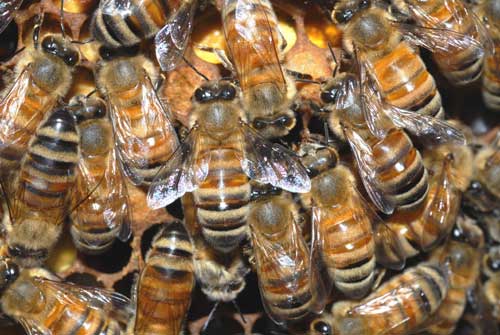
It's not so much eternal life, more a case of instant death. Parasitic beetles that dare to invade the hive of certain stingless bees end up entombed forever in resin. "They're stopped in their tracks and they dehydrate and shrivel up like a mummy," says Mark Greco, an entomologist at the Swiss Bee Research Centre in Bern who discovered the practice in a species of Australian stingless bees, Trigona carbonaria, living in the wild.
Read more ....
Ten Things That Cause Mass Extinctions
From Cosmos:
SYDNEY: It's normal for a species to go extinct, and an average rate of one a year is the natural background rate. But over the past 4.5 billion years, there have been times when extinctions occured at 100 to 1,000 times faster - with the largest event wiping out 95 % of all species. Somewhere between five and 20 such mass extinctions have occured. Here are 10 possible causes for future extinction events.
Read more ....
2010's Hi-Tech Top 10: Brace Yourselves For Touch-Screen Laptops And 3D TV
From The Daily Mail:
The march of technology is unstoppable. Even the credit crunch hasn't slowed the pace of innovation, and it's already looking like 2010 will be another vintage year for consumer electronics.
But it's not just gadget fans who should get excited - movie buffs, game lovers and even bibliophiles will be able to immerse themselves in their passions as never before.
Read more ....
New Internet Piracy Law Comes Into Effect In France
From The BBC:The first effects of France's new law against internet piracy will begin to be felt as the new year begins.
The law was passed after a long struggle in parliament, and in the teeth of bitter opposition from groups opposed to internet restrictions.
Illegal downloaders will be sent a warning e-mail, then a letter if they continue, and finally must appear before a judge if they offend again.
The judge can impose a fine, or suspend their access to the internet.
Read more ....
Vatican Reveals Secret Archives
In a letter dated 1246 from Grand Khan Guyuk, pictured, to Pope Innocent IV, Genghis Khan's grandson demands that the Pontiff travel to central Asia in personFrom The Telegraph:
A 13th-century letter from Genghis Khan’s grandson demanding homage from the pope is among a collection of documents from the Vatican’s Secret Archives that has been published for the first time.
The Holy See’s archives contain scrolls, parchments and leather-bound volumes with correspondence dating back more than 1,000 years.
High-quality reproductions of 105 documents, 19 of which have never been seen before in public, have now been published in a book. The Vatican Secret Archives features a papal letter to Hitler, an entreaty to Rome written on birch bark by a tribe of North American Indians, and a plea from Mary Queen of Scots.
Read more ....
Domain Name Extension 'Could Boost Cyber-Crime'
From Times Online:The introduction of internet addresses in non-Roman scripts could offer fresh opportunities to cyber-criminals, experts have warned.
Next year the Internet Corporation for Assigned Names and Numbers (Icann) will for the first time accept internet domain names in non-Roman scripts. The domain name is the part of a web address that precedes the “dot”, such as timesonline.
The new internationalised domain names will open up the internet as never before to users whose native language does not use the Roman alphabet. But Roman-reading users face a possible deluge of phishing and e-mail scams.
Read more ....
Global Warming ALERT: British Experts Predicting Coldest Winter In 100 Years

From YID With LID:
Word to the British, you better buy a new winter coat. Experts are predicting that this will be one of the coldest winters in the past 100 years. This kind of weather was predicted by scientist, Mojib Latif who back in September predicted that earth was going to cool off for the next 20-30 years. Latif said the cooling would be the result of changes to ocean currents and temperatures in the North Atlantic, a feature known as the North Atlantic Oscillation (NAO) and the NAO may be partly the cause of warming during the past 30 years.
Its ironic that in Britain, home of the Climate Research Unit of the University of East Anglia, recently made famous by the climategate is facing one of the coldest winters in 100 years, experts predict temperatures hitting minus 16 degrees Celsius (+3 Fahrenheit).
Read more ....
Subscribe to:
Comments (Atom)